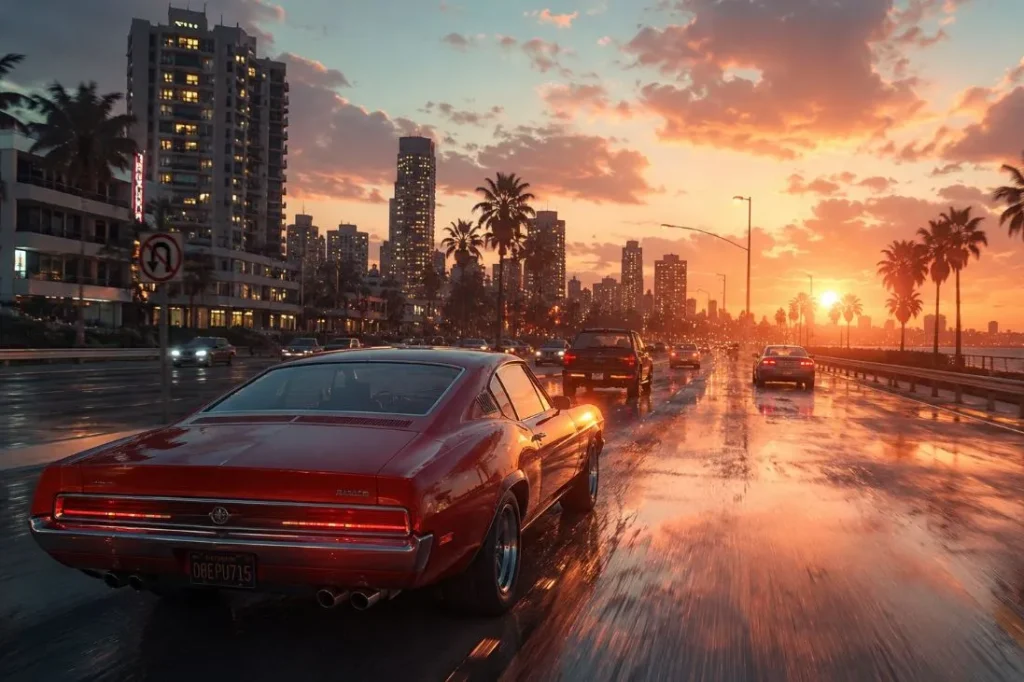
GTA 6 does not need to call itself a racing game to become one of the most interesting driving experiences of its generation. That has always been part of Grand Theft Auto’s strange power. Players arrive for crime, story, satire, chaos and open-world freedom, then spend hundreds of hours doing something much simpler: driving. Not always toward a mission. Not always with a plan. Sometimes just fast, badly, beautifully, across a city that reacts when the car becomes the center of the moment.
With GTA 6, that driving fantasy has a new stage. Rockstar is taking players to Leonida, a fictional state built around Vice City and a wider Florida-inspired landscape. That matters because driving in GTA is not only about vehicle handling. It is about roads, traffic, police, weather, bridges, coastlines, swamps, city blocks, parking lots, nightlife, highways and the way all of those pieces turn movement into play.
If GTA 5 turned Los Santos and Blaine County into a massive driving sandbox, GTA 6 has the chance to go further. Vice City offers neon streets, beachfront cruising and dense urban traffic. Leonida can add wetlands, long bridges, rural stretches, coastal roads, highways and small-town escape routes. The result may not be a traditional racing game, but it could become something more flexible: a living racing playground where speed is only one part of the fun.
Why GTA driving works differently from racing games
A dedicated racing game usually gives the player a clean structure. There is a track, a vehicle class, a start line, a finish line, opponents and rules. GTA driving works because those rules are optional. The player can race, cruise, flee, stunt, drift, role-play, explore, block traffic, cut through alleys, launch off a ramp or simply test how far a damaged car can keep moving.
That freedom gives driving a different emotional texture. A race in a motorsport game is about clean performance. A drive in GTA is about possibility. One wrong turn can become a police chase. A quiet road can become a crash scene. A shortcut can become a stunt. A mission route can become an improvised escape. The city is not background decoration; it is part of the driving system.
GTA 6 could amplify that feeling if Leonida is designed with varied road rhythms. A good open-world driving map needs more than size. It needs contrast. Slow streets make fast roads feel faster. Tight alleys make highways feel open. Long bridges create tension because escape routes are limited. Wide beachfront roads create cruising energy. Industrial zones create stunt possibilities. Rural roads create speed and isolation.
The best racing playground is not just a place with fast cars. It is a place where every type of driver finds a different kind of pleasure.
Leonida could make driving feel like travel, not just movement
One of the most important official details about GTA 6 is the setting: the state of Leonida, with Vice City at its center. That phrase alone suggests a bigger driving identity than a single city grid. A state gives Rockstar more room to build route variety. It can connect dense urban areas with open highways, wetlands, beaches, ports, small towns and wilderness spaces.
This matters because driving becomes more satisfying when routes have personality. In GTA 5, the shift from Los Santos to the desert changed the way vehicles felt. A sports car on a city freeway was different from an off-road truck in Blaine County. GTA 6 can create an even stronger contrast if Leonida uses Florida-inspired geography well.
A racing playground needs places that encourage different habits. Some roads should invite top speed. Others should reward control. Some areas should make traffic part of the challenge. Others should feel open enough for long, uninterrupted runs. A strong GTA map lets players invent their own driving rituals: airport loops, bridge sprints, coastal cruises, police escape routes, drag strips, parking-lot drift spots, backroad time trials.
The likely strength of Leonida is that it can give driving a sense of travel. The player may not only cross distance. They may cross moods: tourist brightness, nightclub glow, swamp humidity, highway emptiness, suburban sprawl, port grit and stormy coastal roads. In an open-world game, those shifts can make ordinary driving feel memorable.
Cars are not just transport in GTA
Vehicles in GTA are tools, status symbols, jokes, weapons, collectibles and toys. A compact car tells one story. A luxury coupe tells another. A battered pickup, a police cruiser, a dirt bike, a supercar, a van, a lowrider, a boat trailer, a stolen SUV — every vehicle changes the player’s relationship with the world.
This is why GTA 6 driving matters before Rockstar even reveals every handling detail. The series has trained players to see vehicles as part of identity. Some players want the fastest car. Others want the best getaway machine. Others care about customization, sound, weight, drift feel or the fantasy of cruising through Vice City at night with no mission marker active.
A strong vehicle system should support different uses rather than one perfect answer. The most interesting GTA garages are not filled only with top-speed monsters. They include cars for mood, terrain, role-play and chaos.
The open world can support several driving styles at once:
- Street racing through city blocks, traffic lights and tight corners.
- Highway pulls where acceleration and top speed matter more than handling.
- Police chases built around shortcuts, ramps, bridges and sudden turns.
- Off-road escapes through wetlands, dirt paths and rough terrain.
- Night cruising where atmosphere matters more than winning.
- Stunt driving with rooftops, construction sites, drainage canals and jumps.
- Social driving in online sessions, where players build meets, convoys and custom events.
This is where GTA can beat more formal racing games for some players. It does not only ask who is fastest. It asks what kind of driver you want to be tonight.
The police chase is GTA’s hidden racing mode
The most iconic GTA driving is not always a race against another player. It is a race against collapse. A police chase turns the city into a track that keeps changing. Roadblocks appear. Traffic becomes a hazard. Sirens create pressure. A clean corner matters because one crash can end the escape. The route is not planned, but the stakes feel immediate.
If GTA 6 improves traffic behavior, police response and vehicle damage, driving could gain enormous tension. Even without confirmed mechanical details, the official trailers and setting already point toward a world built around crime, pursuit and public spectacle. A modern Vice City with dense roads and social chaos could make chases feel less like scripted events and more like emergent racing stories.
A good police chase uses every part of the map. Wide roads let the player build speed. Narrow alleys create risk. Bridges can trap or save. Swamp roads can break line of sight. Parking garages can become hiding spots. Gas stations, docks, construction zones and beach roads can turn into improvised escape tools.
This is why GTA 6 does not need a separate racing campaign to create driving drama. The open world itself can become the event generator. The best chase is not the one the game labels as a mission. It is the one the player creates by making one bad decision and then refusing to stop.
What would make GTA 6 driving feel truly next-generation
Driving in GTA 6 will be judged by more than vehicle count. Players will notice the small things: how cars lean, how tyres grip, how water affects roads, how traffic reacts, how police pursue, how crashes sound, how damage changes control, how motorcycles handle, how boats connect to roads and how believable the world feels when speed disrupts it.
A modern open-world racing playground needs systems that talk to each other. Weather should matter. Traffic should matter. Surface should matter. AI behavior should matter. Damage should matter without becoming frustrating. Customization should feel cosmetic and practical. The city should give the player both beautiful cruising routes and ugly escape routes.
A clear way to read GTA 6’s driving potential is through the systems that could shape everyday play.
| Driving element | Why it matters | What it could add to GTA 6 |
|---|---|---|
| Road variety | Prevents the map from feeling like one repeated route | City sprints, highway runs, coastal cruises and swamp escapes |
| Vehicle handling | Defines whether driving stays fun for hundreds of hours | Distinct cars, better control and more satisfying skill growth |
| Traffic behavior | Makes the city feel alive and unpredictable | Natural hazards, chase chaos and improvised shortcuts |
| Police AI | Turns driving into pressure rather than simple travel | Better escapes, roadblocks and memorable pursuit stories |
| Weather and lighting | Changes mood and road readability | Night racing, wet roads, storms and cinematic cruising |
| Customization | Gives players ownership over vehicles | Car culture, meets, identity and performance tuning |
These systems do not need to be brutally realistic. GTA works best when driving is believable enough to feel physical and playful enough to remain fun. Too much realism could slow the chaos. Too little weight could make cars feel disposable. The sweet spot is controlled madness.
Why Vice City is perfect for car culture
Vice City has always carried a car-culture charge. Neon, heat, music, nightlife, beaches, luxury, crime fantasy and bright roads all make driving feel central to the mood. In GTA 6, returning to that kind of setting could give Rockstar a perfect excuse to build stronger vehicle identity.
Florida-inspired car culture can include several moods at once: supercars near beachfront wealth, lifted trucks away from the city, motorcycles on open roads, lowrider-style cruising, loud street meets, off-road machines near wetlands, boats and cars crossing the same lifestyle fantasy. GTA thrives when these cultures collide.
The open world could become especially strong if it gives each vehicle type a natural habitat. A supercar should feel right on a neon boulevard. A muscle car should feel dangerous on a long straight. A dirt bike should make sense outside the city. A boat should connect with coastal movement rather than sit as a side activity. A police cruiser should feel different from a stolen sports car during a chase.
Car culture also matters for online play. GTA Online proved that players will spend years building garages, organizing races, showing off liveries and inventing their own meetups. GTA 6’s world could become a much richer social driving space if customization, road variety and event tools evolve together.
The racing playground hidden inside missions
Rockstar missions often use driving as connective tissue: go here, escape there, follow this car, intercept that target, lose the police, deliver the vehicle, chase the suspect. In the best moments, the driving is not filler. It becomes the emotional rhythm of the mission.
GTA 6 has a chance to make that rhythm more dynamic. Jason and Lucia’s story, built around crime, dependency and escape, naturally fits driving tension. A bad job can become a highway flight. A quiet meeting can become a sudden chase. A stolen car can become a temporary lifeline. The relationship between characters may even change how driving scenes feel if one is shooting, navigating or reacting while the other controls the vehicle.
The best open-world racing playground is not only found in optional races. It hides inside story missions, side activities, random events and player mistakes. If GTA 6 can make mission driving less rigid and more reactive, the whole game benefits.
A strong driving mission does not need to force cinematic control away from the player. It needs to give the player enough pressure and enough freedom to make the escape feel earned. That is where GTA has always been strongest: when the scripted setup breaks into player-controlled chaos.
Why GTA 6 could compete with racing games without becoming one
GTA 6 will not replace Gran Turismo, Forza Motorsport or hardcore racing simulations. It does not need to. Its advantage is different. Racing games give structure, precision and competition. GTA gives place, improvisation and personality. The player is not only chasing lap time. The player is building a story around the drive.
That difference can make GTA 6 more replayable for casual racing fans than many pure racers. A player may not want to tune suspension or memorize braking zones. They may want to steal a car, test it down a bridge, escape police, crash into a market, repair it, repaint it, race friends and then cruise at sunset. GTA turns driving into a social and narrative activity.
The most important thing Rockstar can do is make ordinary driving feel good. If simply moving through Leonida is satisfying, every other system becomes stronger. Missions improve. Exploration improves. Online play improves. Custom races improve. Police chases improve. Car collecting improves. The world feels larger because the act of crossing it is enjoyable.
The risk: too much spectacle, not enough feel
There is one danger with any massive open-world sequel. Spectacle can become more important than control. A game can show stunning traffic, beautiful reflections, cinematic crashes and crowded streets, but if the cars feel wrong, players will notice. Driving is tactile. It lives in the hands.
For GTA 6 to become a true racing playground, vehicles need personality. A sports car should not feel like a slightly faster SUV. A heavy truck should not corner like a coupe. A motorcycle should require a different mindset. Off-road vehicles should matter outside the city. Damage should affect behavior without making every small crash annoying. Speed should feel dangerous but readable.
The world also needs routes worth repeating. Players naturally create favorite roads. Rockstar should want that. The best open-world driving maps become personal. Players know where to test a car, where to drift, where to jump, where to escape and where to cruise. If Leonida creates those habits, GTA 6’s driving life will last far beyond the story.
Conclusion
GTA 6 may become one of the best racing playgrounds not because it is trying to be a racing game, but because it can make driving part of everything. Leonida gives Rockstar a setting with city streets, highways, coastlines, wetlands and Vice City atmosphere. The crime story gives driving urgency. The open world gives it freedom. The vehicle culture gives it identity.
The strongest version of GTA 6 driving would let players move between moods without leaving the same map: a clean street race, a messy police escape, a late-night cruise, a swamp shortcut, a freeway top-speed run, a parking-lot drift session, an online car meet, a story chase that goes wrong. Few racing games can offer that kind of range because they are built around rules. GTA is built around breaking them.
Until Rockstar shows full gameplay, no one can honestly judge the final handling model. But the ingredients are already powerful: Vice City, Leonida, modern hardware, a crime-driven story and a series history where vehicles have always been more than transport. If the cars feel right and the roads are built with variety, GTA 6 could turn its open world into the racing sandbox many players did not know they wanted most.