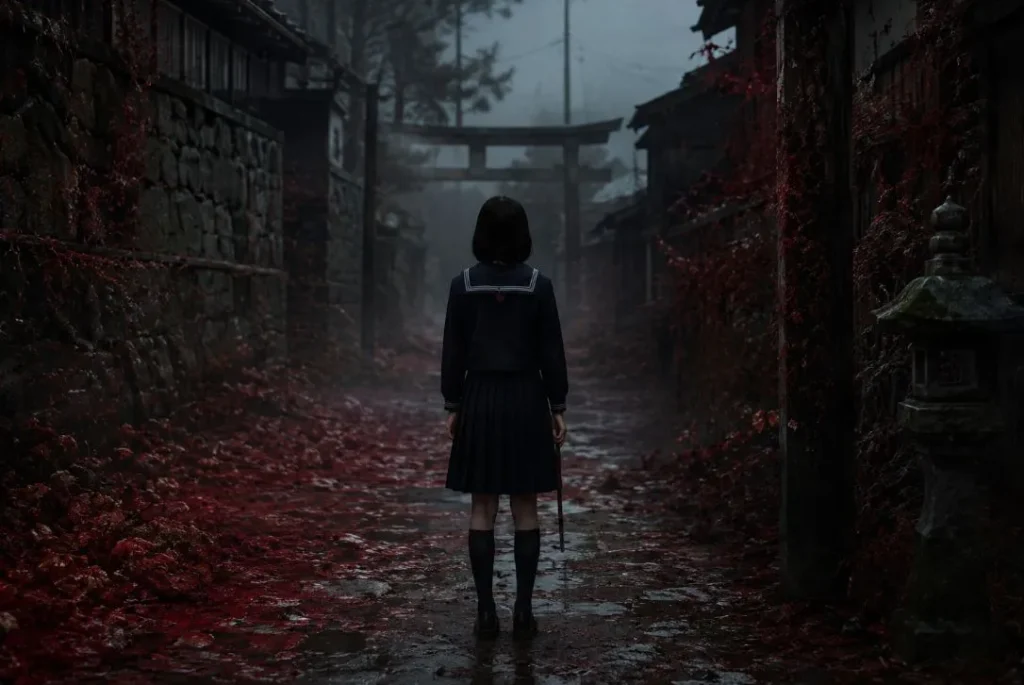
Silent Hill f is the kind of horror game that attracts attention before anyone fully knows what to do with it. The name promises a return to one of gaming’s most unsettling series, but almost everything around it feels slightly displaced: the setting moves to 1960s Japan, the story follows a new teenage protagonist, the familiar American small-town nightmare gives way to rural streets, flowers, fog, body horror and a different kind of cultural unease. It looks like Silent Hill, but not in the most obvious way.
That is why horror fans are watching so closely. Silent Hill f is not simply another sequel trying to repeat Pyramid Head, the rusted Otherworld or the most famous images from Silent Hill 2. It is a new chapter that seems interested in the spirit of the series rather than only its museum pieces. The question is not whether it can copy old Silent Hill. The question is whether it can produce the same feeling of emotional disturbance through a new place, new symbols and a new kind of fear.
After years of uncertainty around the franchise, Silent Hill f arrives at a moment when expectations are unusually sharp. The series has already returned to public conversation through remakes and renewed Konami activity, but a brand-new mainline-style entry carries a different pressure. A remake can be judged against memory. A new Silent Hill has to prove that the nightmare can still evolve.
A Silent Hill game without the usual Silent Hill shape
The boldest thing about Silent Hill f is that it does not begin from the most familiar image of the franchise. For many players, Silent Hill means an American town swallowed by fog, empty streets, sirens, symbolic monsters and characters broken by guilt, grief or repression. Moving the action to 1960s Japan changes the surface immediately.
That move could have been risky if it felt like a simple rebrand, but it also gives the series room to breathe. Silent Hill has never been powerful only because of one location. Its real strength has always been the way place becomes psychological pressure. Buildings, corridors, hospitals, schools, apartments and streets stop being neutral spaces. They begin to reflect fear, memory, shame, desire and punishment.
In Silent Hill f, the remote mountain town of Ebisugaoka gives that idea a new shape. A small community can be just as oppressive as an abandoned American resort town. Rural beauty can become more disturbing than urban decay if the familiar world begins to bloom into something unnatural. The Japanese setting allows horror to come through social pressure, family expectation, folklore, ritual atmosphere and the contrast between delicate beauty and physical corruption.
This is what makes the project interesting. It does not need to ask fans to forget old Silent Hill. It asks whether Silent Hill can survive as a method rather than a map.
Why the 1960s Japan setting matters
A horror setting works best when it carries tension before the monsters appear. The 1960s are important because they place Silent Hill f in a society where tradition, modernization, gender expectations and family structure can all press against one another. Horror does not need to explain all of that directly. It can let the player feel it through homes, clothing, school life, streets, silence and the way characters speak to each other.
This gives Hinako Shimizu’s story a different emotional foundation from earlier entries. She is not another adult arriving in a cursed town with a hidden past in the same familiar shape. She is a young woman inside a world that may already feel restrictive before the fog arrives. When the town changes, the horror can become an external form of pressures that were present from the beginning.
The period setting also changes the texture of fear. Without the comfort of modern technology, communication feels thinner. Isolation becomes easier to believe. A narrow street, a dark home, a school corridor or a shrine path can feel more threatening when the world is not filled with screens, instant messages and constant outside noise.
For horror fans, this kind of setting offers several strong possibilities:
- psychological horror built around family, duty and social expectation;
- monster design that blends body horror with natural or floral imagery;
- a town that feels intimate rather than simply large and empty;
- puzzles and environments shaped by local culture instead of generic horror spaces;
- a protagonist whose fear is connected to identity, age and choice;
- a tone that can feel beautiful and repulsive at the same time.
That last contrast may become the defining feature. Silent Hill f has repeatedly been framed around the idea of beauty inside terror. If the game handles that well, it could give the series a visual identity that feels fresh without abandoning its emotional cruelty.
The Ryukishi07 factor
One reason Silent Hill f stands apart is the involvement of Ryukishi07, best known for stories that mix everyday life, psychological collapse, social suspicion and escalating horror. His name matters because Silent Hill has always needed more than monsters. The series works when the writing makes the player feel that something human is rotting underneath the supernatural.
The strongest Silent Hill stories are not only about surviving creatures. They are about realizing why those creatures feel personal. The enemy design, locations and plot twists matter because they connect to character psychology. If Silent Hill f leans into that tradition, Ryukishi07’s style could fit naturally: ordinary relationships turning unstable, friendship and family becoming sources of dread, small-town life hiding emotional violence beneath politeness.
This does not mean Silent Hill f should become a visual novel in disguise. It still has to function as a survival horror game. But a stronger writerly identity can help the game avoid the most common modern horror problem: impressive creature design without emotional consequence.
The key question is whether the story will trust discomfort. Silent Hill is usually at its best when it lets the player sit with uncertainty instead of explaining every symbol too quickly. Ryukishi07’s involvement raises expectations because fans expect layered character work, not only a chain of shocks.
Combat, puzzles and the fear of becoming too modern
Every modern Silent Hill faces a design problem. If it plays too much like an old game, some players will call it stiff. If it plays too much like a modern action horror title, longtime fans may feel the dread has been replaced by combat loops. Silent Hill f sits directly inside that tension.
The series has never been loved because its combat was elegant. Awkwardness was part of the fear. Players were often vulnerable, clumsy and unsure. At the same time, a 2025 horror release cannot ignore responsiveness, readability and pacing. The challenge is to make the player feel threatened without making the controls feel broken.
Silent Hill f appears to place more visible emphasis on combat than some older fans might expect, but that does not automatically mean the horror is lost. Combat can support fear if it feels costly, dangerous and connected to survival. It becomes a problem only if enemies turn into routine obstacles and the player starts thinking like an action hero.
The same applies to puzzles. Silent Hill puzzles work best when they feel strange but not random, symbolic but still solvable. If Silent Hill f uses its Japanese setting only as decoration, the puzzles may feel ordinary. If it builds them from the town’s spaces, objects, rituals and emotional themes, they can become part of the atmosphere.
A strong modern Silent Hill needs balance in several places:
| Element | What fans hope for | What could go wrong |
|---|---|---|
| Combat | Threatening encounters with weight and consequence | Too much action, too little dread |
| Puzzles | Strange logic tied to place and story | Generic locks, keys and forced riddles |
| Monsters | Symbolic creatures with emotional meaning | Designs that look cool but say little |
| Exploration | Dense spaces with unease and discovery | Over-guided routes with no mystery |
| Story | Psychological tension and character depth | Excess explanation or shallow shock value |
| Sound | Silence, distortion and memorable audio dread | Constant noise that weakens fear |
This is why fans are not only asking whether Silent Hill f looks scary. They are asking what kind of scary it wants to be.
Strange beauty as the new hook
The most memorable horror often understands beauty. A disgusting monster is one thing. A beautiful image that slowly becomes disgusting can be much harder to forget. Silent Hill f seems built around that second idea. Flowers, soft colors, feminine imagery, rural landscapes and bodily corruption can create a tension that feels different from rust, metal and industrial decay.
That matters because Silent Hill needed a new visual language. Reusing the old Otherworld too directly would have been easy, but it also would have made the game feel trapped under Silent Hill 2’s shadow. A floral nightmare can still be grotesque, but it carries different meanings: growth, infection, blooming, fragility, beauty becoming invasive, nature taking over the body.
For a story centered on a teenage girl in a restrictive setting, that imagery could be powerful if handled carefully. Flowers can suggest youth, expectation and ornament. They can also suggest suffocation, transformation and loss of control. The best horror images often work because they are not only scary; they are contradictory.
This is one of the clearest reasons horror fans are watching. Silent Hill f has the chance to look unlike every other entry while still feeling psychologically connected to the series. If the beauty is only surface decoration, the effect may fade. If the beauty becomes part of the story’s cruelty, the game could leave a lasting mark.
Why the franchise needed this kind of risk
Silent Hill could not survive forever by circling the same few icons. The series’ reputation is enormous, but that reputation can become a trap. Fans love Silent Hill 2, but constant imitation of Silent Hill 2 weakens the series. The franchise needs new wounds, new places and new symbols.
Silent Hill f is interesting because it accepts that risk. It takes the brand away from its safest geography. It changes the cultural frame. It introduces a new protagonist and a setting that does not automatically rely on old monsters. That is exactly the kind of move a long-running horror series needs if it wants to feel alive rather than preserved.
Horror fans often complain when franchises repeat themselves, then panic when a franchise changes too much. Silent Hill f sits inside that contradiction. It is being watched because it might be the wrong kind of different, but also because difference is the only way to make Silent Hill dangerous again.
The smartest path is not to reject the old games. It is to understand what made them work beneath the surface:
- The horror must come from character, not only environment.
- The town must feel like a psychological space, not only a map.
- Monsters should express something beyond threat.
- Silence should matter as much as spectacle.
- The story should leave space for interpretation.
- The player should feel unsettled after turning the game off.
If Silent Hill f follows those principles, the new setting becomes strength rather than betrayal.
The pressure after Silent Hill’s revival
Silent Hill f also arrives during a larger revival of the franchise. That changes how people read it. If the series were completely dormant, any new entry would be judged mainly as a comeback. Now, fans are comparing multiple forms of return: remakes, new projects, experiments and legacy expectations. Silent Hill f has to define itself inside that crowded return.
That pressure may actually help. A remake can restore confidence, but a new entry can show whether the franchise has a future. Silent Hill f is the test of imagination. It asks whether Konami can do more than reopen the archive. It asks whether Silent Hill can still produce fresh unease.
The game’s early commercial attention also shows that fans are not tired of the name. They are hungry for something that feels serious, strange and worthy of the brand. But interest can cut both ways. The more people want Silent Hill to matter again, the more sharply they will judge the result.
A horror game does not need to please everyone to succeed. In fact, some of the best horror refuses comfort. Silent Hill f may benefit from being divisive if the division comes from bold ideas rather than weak execution. A strange chapter should not feel focus-tested into safety.
Who Silent Hill f is really for
Silent Hill f is likely to attract several different audiences at once. Longtime fans will come looking for psychological horror and symbolic design. New players may come because the Japanese setting and modern presentation feel more accessible than older entries. Fans of Ryukishi07 may come for the writing. General horror players may come because the visual identity is unusual.
Those audiences may not want the same thing. Some want slow dread. Some want combat tension. Some want story complexity. Some want disturbing creature design. Some want the return of classic Silent Hill atmosphere. That mix creates expectation pressure, but it also gives the game a wide emotional reach.
The players most likely to appreciate Silent Hill f are those willing to accept a Silent Hill game that does not behave exactly like the past. If someone wants only a direct recreation of Silent Hill 2’s mood, this may feel too different. If someone wants horror that uses beauty, culture, character and discomfort in a new arrangement, Silent Hill f becomes far more compelling.
Conclusion
Horror fans are watching Silent Hill f because it has the rare combination of legacy and uncertainty. The name carries history, but the game does not look predictable. It has a writer associated with psychological unease, a setting that changes the franchise’s usual geography, a protagonist who can carry a more intimate story and a visual hook built around beauty turning wrong.
That is enough to make the game important even before judging every system in detail. Silent Hill has always been strongest when it made players feel that horror was not outside the character, but already tangled inside them. Silent Hill f seems positioned to explore that idea through a different cultural and emotional lens.
The risk is obvious. It could be too different for traditionalists, too action-oriented for purists or too symbolic for players who want direct answers. But horror needs risk. A safe Silent Hill is almost a contradiction. The franchise became legendary because it was willing to be uncomfortable, strange, slow, ugly, beautiful and emotionally unpleasant.
Silent Hill f is being watched because it might bring that danger back in a form the series has not used before. Not by returning to the same streets again, but by proving that fog can settle somewhere new and still feel personal.