Long before digital storefronts reduced video game packaging to tiny thumbnail images, walking into a computer shop in the late nineteen-eighties was a highly tactile, visual adventure. Among the rows of floppy disk boxes, certain titles commanded attention not just as games, but as premium works of fantasy. This immediate aesthetic dominance was the hallmark of Psygnosis, a Liverpool-based publisher that revolutionized the industry by treating its releases with the reverence of gatefold vinyl records. Central to this pioneering branding strategy was the legendary artist Roger Dean, whose surreal, organic landscapes transformed game packaging into portals to impossible worlds. Through this collaboration, psygnosis cover art became an artistic movement in its own right, permanently elevating the cultural status of early home computer software.
The birth of a brand through organic fantasy
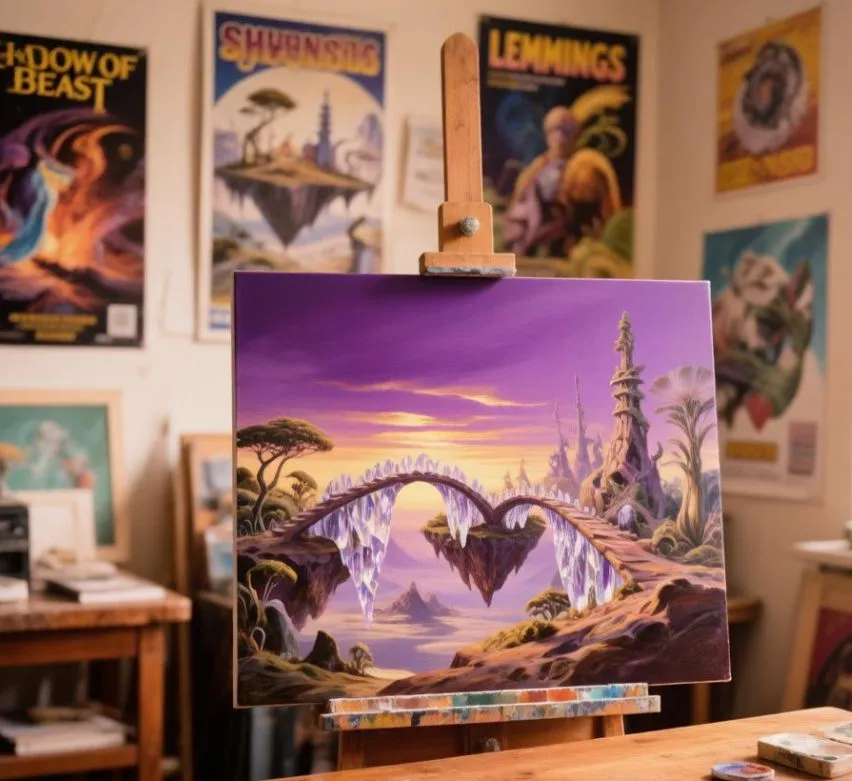
When Psygnosis was founded in 1984, the founders realized that to stand out in a saturated market, they needed a cohesive, high-end visual identity. They turned to Roger Dean, an artist already famous worldwide for his progressive rock album covers for bands like Yes and Asia. Dean did not simply draw characters; he designed entire ecosystems populated by fossilized structures, sweeping arches of rock, and alien biomes. His first major contribution was the company’s famous mascot: a stylized, biomechanical owl that looked both ancient and futuristic. This emblem immediately signaled to consumers that they were buying something sophisticated, mysterious, and technologically advanced.
Translating canvas to interactive silicon
The real magic occurred when Dean’s canvas paintings were paired with the advanced graphical capabilities of the Commodore Amiga. Games like Obliterator and Terrorpods were packaged in oversized boxes that prominently featured his masterworks, creating an unprecedented sense of scale and wonder before the player even booted up the floppy disk.
To understand how these artistic visions translated into commercial products, we can examine several key collaborations where the illustration style directly influenced the thematic atmosphere of the release:
| Title | Release year | Visual hallmarks | Emotional impact |
|---|---|---|---|
| Brattacus | 1986 | sweeping monolithic structures and heavy atmospheric mist | a sense of isolation in an ancient, high-tech world |
| Obliterator | 1988 | biomechanical alien landscapes and towering organic machinery | claustrophobic dread coupled with sci-fi grandeur |
| Shadow of the Beast | 1989 | fossilized trees, jagged crags, and strange horned creatures | an eerie, melancholic fairy tale feel |
| Terrorpods | 1987 | massive tripod structures marching across desolate white deserts | industrial intimidation and extraterrestrial threat |
This alignment of packaging and game atmosphere created a powerful feedback loop for the consumer. The artwork did not merely decorate the box; it set the emotional baseline for the gameplay, making the low-resolution sprites on screen feel like part of a much grander, infinitely detailed universe.
The shadow of the beast and the pinnacle of the aesthetic
Nowhere was this synergy more potent than in the release of Shadow of the Beast. The game itself was a technical tour de force, boasting unprecedented layers of parallax scrolling and an haunting pan-flute soundtrack. However, it was the packaging that cemented its legendary status. The game arrived in a massive, lavishly printed box featuring Dean’s painting of a menacing, multi-armed creature set against a backdrop of twisted, skeletal mountains.
The design philosophy behind this iconic release relied on several core principles that separated the publisher from its contemporaries:
- The rejection of literal interpretation: the cover did not show actual screenshots or literal game levels, opting instead to capture the pure emotional tone of the world.
- The oversized canvas format: using large cardboard boxes allowed the artwork to be appreciated in its full glory, complete with custom typography designed by Dean himself.
- The integration of physical extras: including full-sized posters and t-shirts inside the box, turning the purchase into a premium collector’s item.
- The cohesive color palettes: utilizing gradient transitions and alien blues, greens, and ochres that matched the vibrant color capabilities of the Amiga hardware.
These decisions ensured that the game was perceived as a prestige product, forcing other industry publishers to abandon cheap, amateurish illustrations in favor of professional, fine-art standards.
Evolution into the 32-bit era and beyond
As the industry transitioned from the Amiga to the 32-bit power of the Sony PlayStation, the landscape of game design underwent radical changes. Yet, the foundational identity built on roger dean game art remained a vital asset for the company. Even when the studio embraced ultra-modern, techno-centric aesthetics for futuristic racers, the organic, otherworldly philosophy established in the eighties continued to guide their creative direction. The legendary owl logo remained a seal of quality, assuring players that they were about to enter a game world crafted with genuine artistic vision.
The long-term impact of this golden era of software packaging can still be felt in the modern gaming landscape, leaving behind a series of enduring legacies:
- The birth of collectors editions: establishing the precedent that physical packaging can be a high-end art piece worth preserving.
- The rise of artist-driven branding: proving that a single illustrator’s style can define an entire publisher’s corporate identity.
- The inspiration for modern indie games: influencing contemporary retro-styled developers who strive to capture that same mysterious, atmospheric dread.
- The validation of games as art: offering tangible proof to critics that interactive media could be married to world-class surrealist painting.
This artistic legacy reminds us that the power of a video game begins long before the console is switched on. By treating game boxes as canvases for fine art, the creative partnership between a visionary illustrator and a daring publisher created an unforgettable aesthetic era that continues to inspire dreamers and designers today.