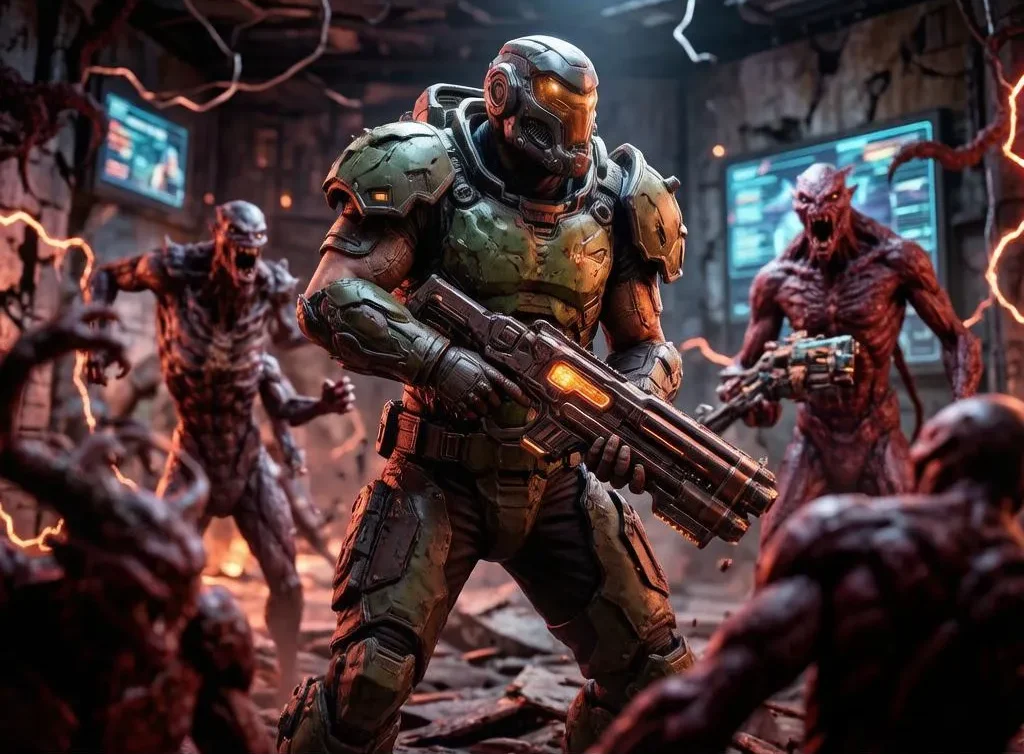
DOOM Eternal rewrote the rules of what a first-person shooter could feel like. No cover, no crouching, no waiting for health to regenerate: just constant forward motion, a resource loop that punishes hesitation, and combat arenas designed like puzzles made of demons. Finishing it leaves a strange hunger, because so few shooters play at that tempo. The market is bigger than it seems, though. Several modern titles chase the same adrenaline, some older classics planted the seeds DOOM Eternal harvested, and a handful of indie games push the formula in directions id Software never tried. Everything below is worth your time, grouped by what makes each one special and how closely it mirrors that Eternal feeling.
What defines the DOOM Eternal formula
Before matching games to the craving, it helps to know exactly what makes Eternal distinct, because “fast FPS” covers everything from arena shooters to boomer-shooter revivals. Eternal’s identity rests on a few pillars that any worthy alternative should share in some form. Recognizing them also helps you decide which direction you actually want to go next:
- Aggression as a survival mechanic. Standing still is death; resources drop only when you push forward, so the game punishes the cautious instincts other shooters teach.
- The combat resource loop. Glory kills restore health, chainsaws and flamethrower fuel restore ammo, and armor comes from flame belches. Every enemy is a vending machine you must attack to earn.
- Momentum without cover systems. Movement options like dashing, double jumping, and grappling keep encounters fluid rather than positional.
- Arena design with escalation. Fights are choreographed encounters where new enemy types arrive mid-battle, forcing loadout improvisation in real time.
- Weapon mastery and counterplay. Each demon has a weak point, each weapon has a role, and mastery means chaining both at speed.
Games that borrow all five pillars feel closest to Eternal. Games that borrow two or three often offer something Eternal lacks, like narrative depth or roguelike variety, which can be an even better fit depending on what you actually loved. The comparison section sorts the field by exactly that distinction.
The strongest alternatives compared
Each candidate below brings a different slice of the Eternal experience, from faithful imitations to deliberate reinterpretations. The overview maps out style, how close the feel is, and what each game does that Eternal does not, since that difference often decides the pick.
| Game | Closest to Eternal in feel | What it adds instead |
|---|---|---|
| DOOM (2016) | Very close | More atmospheric pacing, stronger story framing |
| Titanfall 2 | High | Wall-running, mech combat, brilliant campaign |
| Ghostrunner | High | One-hit-kill precision, cyberpunk parkour |
| ULTRAKILL | Very close | Rank-chasing style meter, retro-inspired visuals |
| Doom-like indie hit Dusk | Medium | 90s atmosphere, horror-tinged arenas |
| Severed Steel | High | Bullet-time, destructible cover, one-armed protagonist |
| Warhammer 40,000: Boltgun | Medium | Grimdark atmosphere, classic sprite revival |
| Brutal Doom mod | High | Reimagined classic DOOM with Eternal-style brutality |
| Metal: Hellsinger | Medium | Rhythm-based shooting tied to metal music |
| Neon White | Medium | Speedrunning card-based movement puzzles |
The nearest neighbors, DOOM 2016, ULTRAKILL, and Titanfall 2, sit at the top because their combat loops demand the same relentless tempo. Titles lower in the list trade some of that proximity for distinctive ideas: Metal: Hellsinger makes timing a mechanical skill, while Ghostrunner strips away gunplay entirely in favor of sword dashes. Understanding which axis matters most to you, tempo or variety, makes the shortlist below much easier to navigate.
The picks in depth
DOOM (2016) is the obvious first stop and still the most direct sibling. Its combat loop is the ancestor of Eternal’s, though it plays slower, favors shotgun-heavy burst encounters, and weaves exploration into the arenas. If you loved Eternal’s aggression but found its platforming exhausting, 2016 is the gentler, moodier cousin. If you found Eternal’s arena fights too scripted, 2016’s looser encounters feel more improvised.
ULTRAKILL is what happens when indie developers take Eternal’s combat loop and crank every dial past ten. Ranking systems reward style chains across entire levels, blood becomes literal currency for healing, and difficulty tiers escalate until the highest setting transforms the game into a mechanical exam. It runs on nearly any modern PC, costs a fraction of a AAA title, and its community mods add years of content. The retro visual style takes an hour to acclimate to, after which it becomes part of the charm.
Titanfall 2 deserves its reputation as one of the finest FPS campaigns ever built. Its movement system, wall-running, double jumping, and grapple hooks, captures Eternal’s fluidity while adding vertical dimension no other shooter on this list attempts. The mech sequences function as pacing breaks rather than interruptions, and the campaign’s design has influenced every fast shooter since. Multiplayer still functions, though the campaign alone justifies the purchase.
Ghostrunner inverts the formula. Instead of enduring hits while dealing damage, you die to anything, which forces the same Eternal lesson: constant motion, split-second timing, and memorizing enemy patterns until encounters become choreography. Each level is a combat puzzle with one intended solution executed at breakneck speed, and the cyberpunk setting gives it an identity entirely separate from demon-slaying.
Severed Steel compresses Eternal’s ethos into something small and frantic. The one-armed protagonist leaps, slides, and slow-mos through destructible arenas, and the entire game plays like an action movie choreography exercise. Its brevity becomes a feature, perfect for a weekend burst rather than a long campaign commitment.
Warhammer 40,000: Boltgun wraps a boomer-shooter revival in the grimdark 41st millennium. The sprite-heavy visuals pay homage to the 1990s while the combat emphasizes chainsword-melees and over-the-top executions, echoing Eternal’s flamboyance without copying its structure. It is the pick for players who want the feel of classic DOOM with a fresh thematic coat.
Metal: Hellsinger deserves mention for a mechanic no other fast FPS attempts: damage output ties directly to shooting on rhythm. The soundtrack, performed by metal vocalists, turns every encounter into a tempo exercise, and the sense of flow when the beat locks in rivals any other game on this list. It is shorter and more constrained than Eternal, but the rhythm loop is genuinely novel.
Neon White plays like a speedrunning puzzle game wearing an FPS costume. Cards double as weapons and movement abilities, levels are measured in seconds, and leaderboards drive replay for weeks after the credits. Anyone who loved Eternal’s movement mastery but wants a competitive, score-chasing structure will find Neon White an unexpected obsession.
Where the classics fit in
Modern titles dominate this list for good reason, but the roots of the genre remain playable and worth revisiting. Understanding where Eternal’s DNA came from deepens appreciation for every game above, and several retro options run effortlessly on modern hardware. The essential ancestors include:
- DOOM (1993) and DOOM II. The originals still hold up, especially with modern ports that add widescreen support and mouse look, and they run on literally anything.
- Quake and Quake III Arena. The movement-heavy foundation of every arena shooter, with a remaster that modernized everything for current platforms.
- Serious Sam series. Massive enemy crowds and open arenas, the closest retro equivalent to Eternal’s swarm management.
- Painkiller. An early-2000s cult classic with stylized arenas and a card-based scoring system that predates modern style meters.
Playing these is less about nostalgia than context. Eternal’s design language reads as a direct response to what these games established, and seeing the throughline makes the modern titles feel like chapters in one continuous evolution rather than isolated releases.
Choosing your next obsession
With so many options, the deciding factor is usually what aspect of Eternal you want more of. Match your craving to the right category, and the choice narrows to one or two obvious candidates:
- More of the same intensity, with tighter loops and higher skill ceilings: start with ULTRAKILL, then Ghostrunner if you want pure precision.
- The same feel with a fresh coat of atmosphere: DOOM 2016 for demon lore, Boltgun for grimdark gunplay, or Dusk for horror pacing.
- Movement mastery as the core hook: Titanfall 2 for vertical fluidity, Neon White for speedrunning, Severed Steel for acrobatic chaos.
- A novel mechanic on top of fast combat: Metal: Hellsinger for rhythm, Brutal Doom for overhauled chaos, or the Serious Sam series for crowd-scale spectacle.
There is no wrong starting point, but the first pick tends to shape expectations, so choose the category that matches what you actually miss rather than the game with the best trailer. Most players find their second pick in a different category, which is how a single DOOM Eternal hangover quietly becomes a long-term hobby.
Hardware, settings, and expectations
Fast FPS reward high frame rates more than raw visual fidelity, and Eternal itself set the standard with a locked 60 fps requirement that shaped how the genre thinks about performance. Every game on this list benefits from the same treatment, and the adjustments are similar across titles:
- Prioritize frame rate over resolution. A stable 144 fps at 1080p outperforms a stuttering 60 fps at 4K in every fast shooter.
- Cap the frame rate at a value your system sustains. Consistency matters more than peaks, and a locked frame rate eliminates most input timing surprises.
- Reduce motion blur and film grain immediately. Both effects obscure fast motion and add latency in visual processing that fast games punish.
- Consider a high refresh rate monitor. The upgrade from 60 Hz to 144 Hz transforms every game on this list, often more than a GPU upgrade would.
- Keep response time settings aggressive. Fast shooters expose any input lag, so wired peripherals and low-latency modes are worth the small effort.
None of these adjustments demand expensive hardware, and most are free. The genre rewards players who treat their setup as part of the skill expression, and small optimizations compound noticeably over dozens of hours.
After Eternal, the genre opens up
DOOM Eternal raised the ceiling for fast FPS design, and the industry has spent years responding. Some successors refined its ideas directly, others stripped them down, and a few took the tempo in directions id Software never considered. The games above represent the best of that response as of 2026, and the genre shows no sign of slowing down. Start with whichever pick matches your specific craving, give it a few hours to establish its own rhythm, and you may discover that the itch Eternal left behind was never about demons at all. It was about speed, aggression, and the satisfaction of a loop mastered, and that feeling has more homes in modern gaming than any single franchise.