
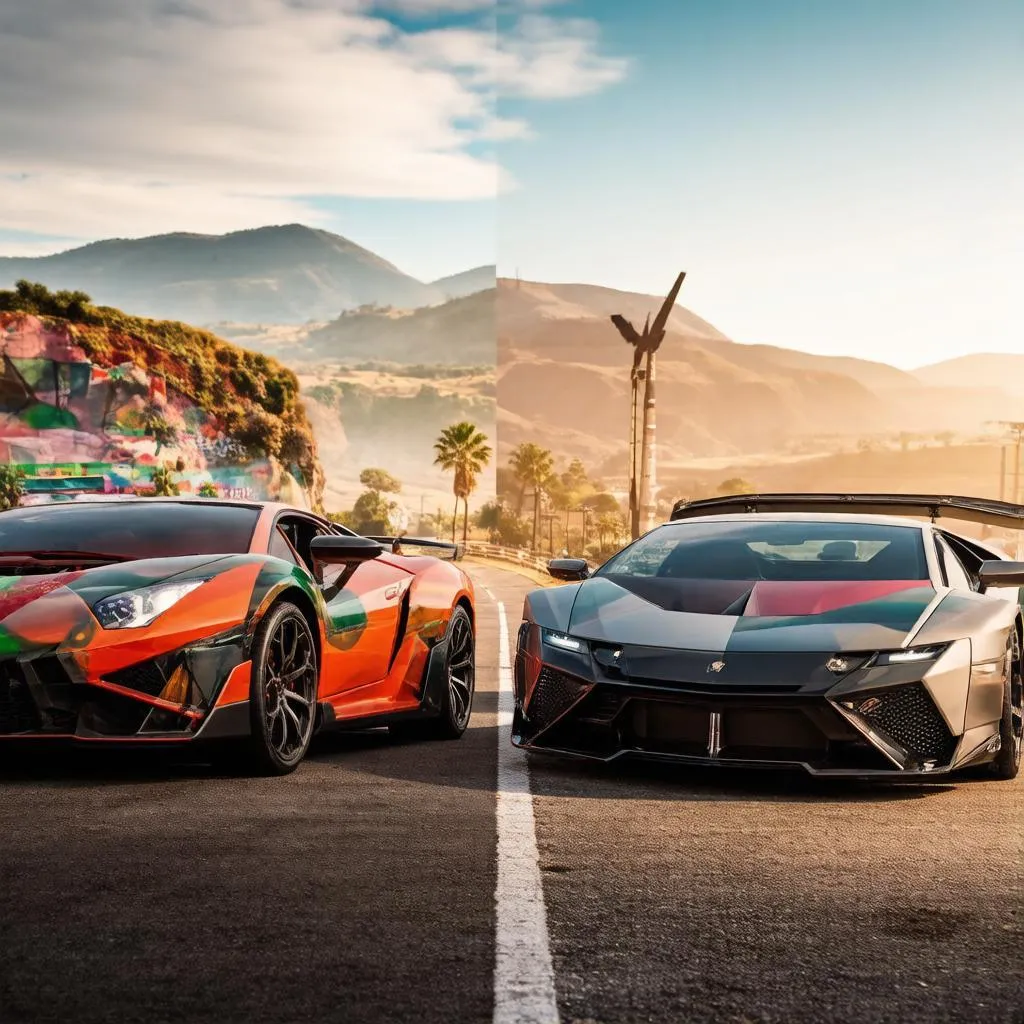
The annual debate in the Horizon community has an unusual shape this year, because for the first time both sides of it are genuinely alive. Forza Horizon 5 launched in November 2021, conquered Mexico, passed forty million players on the way to more than forty-five million, and keeps receiving updates years after release. Forza Horizon 6 arrived on May 19, 2026, moved the festival to Japan, scored a 92 on Metacritic as the highest-rated game of the year so far, and earned roughly $197.7 million on PC in its first two months, collecting revenue three times faster than its predecessor did. That means the usual advice of “just buy the newest one” no longer settles the question. The right choice depends on your hardware, your taste in terrain, and how much you value a finished, polished world versus an evolving one. Here is how the two festivals actually compare, and where each one earns your hours.
Two festivals, two philosophies
Forza Horizon 5 and 6 are separated by less mechanical distance than any two consecutive entries in the series. Playground Games refined rather than reinvented the formula for the sixth entry, so both games share the same open-world DNA: road, dirt, and cross-country events, drifting and speed traps, seasonal changes, and a festival structure that turns progression into a celebration. The differences live in the details, and the details matter more than usual this generation.
FH6 is set in Japan, the single most requested location in the franchise’s history. The map spans fictionalized versions of the Kantō, Chūbu, and Kansai regions, compressing Tokyo-style city streets, elevated expressways, the Japanese Alps, bamboo forests, rice paddies, coastal highways, and even a snow corridor modeled on the real Yuki-no-Otani pass into the largest and most varied Horizon world ever built. FH5’s Mexico offers a different flavor of diversity: jungles, deserts, volcanoes, beaches, and the ancient ruins that gave the game its postcard identity. One map is dense, vertical, and urban; the other is open, sprawling, and scenic. Neither is objectively better, but they reward different moods, and that contrast shapes everything else in the comparison.
The head-to-head overview
With both games living side by side, the practical differences fit into a handful of categories that determine day-to-day enjoyment. The overview captures the essentials before the deeper sections unpack what each line means in practice.
| Category | Forza Horizon 5 | Forza Horizon 6 |
|---|---|---|
| Setting | Mexico | Japan, including Tokyo-inspired city and the Alps |
| Launch car count | Around 500 | More than 550, with 618+ including DLC |
| Map scale | Around 10 miles north-south | Around 21 miles north-south |
| Progression | Loose, everything unlocked early | Wristband system with class-restricted races |
| Major expansions | Hot Wheels and Rally Adventure | First expansion still ahead |
| Platform reach | Xbox One, Series X/S, PC, PS5 | Xbox Series X/S and PC; PS5 on January 26, 2027 |
| Minimum requirements | GTX 970, 8 GB RAM | GTX 1650, 16 GB RAM |
| Signature multiplayer | Horizon Arcade and convoys | Car Meets, Drift Attack, and Horizon CoLab |
Read as a whole, the column comparison favors FH6 on almost every technical axis, while FH5 wins on platform reach, price stability, and the sheer depth of five years of accumulated content. Those are the two poles every remaining section orbits: the sixth entry is the sharper experience today, and the fifth is the safer, more complete package.
Where Forza Horizon 6 pulls ahead
The sixth entry’s advantages cluster around three pillars: the map, the progression overhaul, and the social layer. Each one fixes a specific criticism that followed FH5 through its entire life cycle.
The Japan map itself is the headline. Reviewers repeatedly describe Tokyo as the most complex city the series has ever built, with elevated expressways stacking over dense streets, tunnels that produce genuine engine-sound reverb, and rain reflecting off wet asphalt in ways FH5 never managed. Water, vegetation, sand, and road-surface textures all received visible overhauls, tire smoke behaves more naturally, and lighting exposure fixed the dark-interior view problem that plagued cockpit players in FH5. The map’s verticality, climbing and descending constantly thanks to overpasses and mountain serpentine roads, makes even familiar route types feel new.
Progression received the overhaul veterans had asked for since launch. FH5 handed players near-unlimited money and top-tier cars almost immediately, which some loved and others felt hollow. FH6 introduces wristbands that gate access to higher-tier races, so even a garage full of Ferraris waits behind lower-class events. Two meters fill as you play, one for the Horizon Festival and one for discovering Japan, and filling them unlocks more of the map’s content. A Collection Journal tracks every car, event, and region explored, giving the campaign a clearer sense of momentum than FH5 ever had.
The social layer expanded most visibly. Car Meets let players gather, show off builds, download tuning setups, and form convoys; Time Attack and Drag Meets launch directly from the open world without a separate matchmaking screen; and the September 2026 Series 5 update added a permanent Drift Attack mode. Horizon CoLab extends the EventLab toolkit so players can build events collaboratively rather than alone. Meanwhile, the sixth entry also overhauled visual customization, adding more than a hundred wheel designs with independent front and rear fitment, independent bumper and wing coloring, liveries on glass, and new candy and metal-flake paint finishes.
What Forza Horizon 5 still does better
None of that makes FH5 obsolete, because the older game holds several advantages the newer one cannot match yet. Buying a three-hundred-hour game is a commitment, and these are the reasons the 2021 entry remains a legitimate first pick rather than a placeholder. FH5’s remaining strengths include:
- Two finished expansions. Hot Wheels and Rally Adventure are complete, polished campaigns that FH6 cannot match until its own expansion arrives, and both are included in the FH5 Premium bundle.
- Lower hardware demands. FH5 runs acceptably on a decade-old CPU with a GTX 970, while FH6 officially requires a GTX 1650 and 16 GB of RAM, with a recommended setup of an RTX 3060 Ti or RX 6700 XT.
- A mature EventLab library. Five years of community-built courses, modes, and recreations means FH5’s creative ecosystem dwarfs the young one FH6 is still growing.
- Xbox One support. Owners of the older console have exactly one option in this comparison, and it runs the modern entries’ shared engine well.
- Deep discounts. Years of sales place FH5 bundles at a fraction of FH6’s launch price, and every content update the game has already received is included.
- A proven, stable post-launch state. FH5’s bugs are known, its balance is settled, and its seasonal calendar is fully stocked, while FH6 is still working through launch issues such as grass pop-in and early save glitches.
The pattern is easy to summarize: FH5 is a finished painting, and FH6 is a canvas that already looks magnificent but gains a stroke every month. Which stage of that process you prefer to enter depends on what you want from your next hundred hours.
The multiplayer question deserves its own answer
Both games run the same underlying online framework, so anyone hoping for a fundamentally different multiplayer experience will not find one. Convoys, co-op cruising, competitive circuits, drift events, and party modes such as the elimination rounds and hide-and-seek carried over intact. What FH6 changes is the texture of shared play in the open world. Car Meets create natural gathering points where builds are displayed and exchanged, class-restricted races ensure competition comes down to driving rather than tuning budgets, and the ability to build shared spaces through CoLab gives communities a reason to coordinate. A well-populated FH6 open world simply feels busier and more social than FH5’s, though owners of the older game with an established friend group have little mechanical reason to migrate.
Hardware and the cost of Japan’s detail
The technical jump is real, and it has a price tag. FH6 renders denser vegetation, more dynamic water, and a far more complex urban environment than FH5, which pushes its minimum requirements up by a GPU generation and doubles the RAM floor. Players with mid-range rigs from before 2021 should honestly assess their hardware before choosing, because FH5 on high settings often looks better than FH6 fighting for frames. On capable hardware the equation inverts: FH6’s brighter exposure, reworked lighting, and heavier geometry put it visually a step beyond anything the fifth entry can produce, and comparisons of the two running side by side show the gap most clearly in water, plant life, and night driving.
One practical note softens the hardware concern: both games are day-one Game Pass titles, and FH6 is available through PC Game Pass, which makes testing performance on your own machine free before committing any money. That trial window answers the hardware question more reliably than any benchmark list.
Which festival fits your situation
With the comparison laid out, the decision comes down to your specific circumstances rather than abstract scores. Most players fall cleanly into one of the scenarios below, and each points at a clear answer:
- You are brand new to the series. Start with FH6; its clearer progression, wristband-gated races, and denser map make it the best first step into modern Horizon.
- Your PC is aging but functional. Choose FH5, which remains one of the best-looking games a GTX 970-class machine can run and will not punish older hardware.
- You already own FH5 with substantial progress. Stay in Mexico until the first FH6 expansion or a significant sale, unless Japan’s setting alone justifies the purchase for you.
- You care most about city driving, touge duels, and car culture. FH6 was built for exactly this audience, from JDM-heavy car lists to mountain-pass events that play unlike anything in FH5.
- You own an Xbox One or play primarily on PS5. FH5 is the only option for the former today, and the safer purchase for the latter until FH6’s January 26, 2027 PlayStation launch is actually in your hands.
- You want maximum content per dollar immediately. FH5’s two expansions, years of events, and discounted bundles deliver more hours per currency unit than any FH6 edition currently does.
There is no scenario where the wrong choice ruins the experience, since both games deliver the same core driving loop at a high level. The scenarios simply determine which version of the Horizon formula serves you best today versus six months from now.
The verdict for late 2026
Forza Horizon 6 is the better game on better hardware, and the numbers agree with the eyes: a 92 Metacritic score, record car counts, and revenue pacing that suggests players agree with the critics. Its weaknesses are growing pains, temporary by nature and shrinking with every monthly update. Forza Horizon 5 is the better value on modest hardware, with two expansions, four years of polish, and a content library that the newer entry will need time to match.
If you can run it, FH6 earns the recommendation, particularly for newcomers and anyone drawn to Japan’s tight streets and mountain passes. If your rig predates the requirements, your budget is tight, or your heart belongs to Mexico’s open desert roads, FH5 remains a world-class festival in its own right, not a consolation prize. The rarest outcome would be regret either way, because both halves of this comparison stand among the finest open-world racers ever made, and the only real mistake would be waiting for a hypothetical winner while two outstanding festivals are already running.