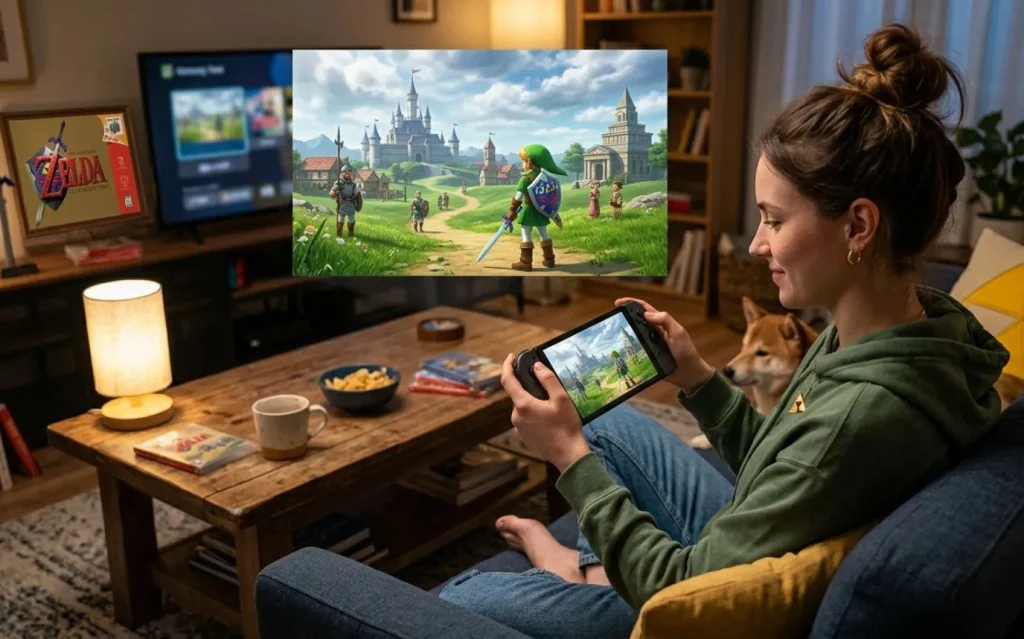
A Zelda: Ocarina of Time remake on Switch 2 feels almost too obvious, which is exactly why it makes sense. Nintendo has always understood the emotional power of its own history. The company rarely treats nostalgia as a dusty archive. It turns memory into events: a familiar title returns, a classic theme plays, an old world appears with sharper light, and suddenly several generations of players are paying attention at once.
Ocarina of Time is not just another old Zelda game. It is one of the games that taught a generation what 3D adventure could be. Lock-on combat, a fully explorable Hyrule, time travel, dungeon logic, horseback movement, music as interaction, cinematic boss fights, adult and child Link, Ganondorf as a mythic threat — so much of modern action-adventure design can still be traced back to it. Even players who never owned a Nintendo 64 often know its reputation.
That is why the idea of a Switch 2 remake lands differently from a routine remaster. Nintendo does not need to explain why Ocarina matters. The name does half the marketing work before a trailer even begins. The real challenge is sharper: how do you remake a game that many fans already consider sacred without turning it into either a museum piece or a modern product that loses the strange magic of the original?
Nintendo knows how to turn memory into a launch-window weapon
A new console needs more than power. It needs emotional certainty. Players want to know why they should care now, not someday. A major remake of Ocarina of Time would give Switch 2 something very valuable: a game that feels both safe and enormous. Safe because the source material is beloved. Enormous because the Zelda name still has rare cross-generational force.
Nintendo has used this kind of strategy before, though not always in the same form. It revisits Mario, Zelda, Metroid, Kirby and other legacy series when the timing is right. Sometimes it does a remake. Sometimes it does an enhanced version. Sometimes it builds an anniversary collection or places classics inside a subscription library. The company understands that old games do not only sell to old fans. They give younger players a way to enter a legend without needing original hardware.
Ocarina of Time is especially useful because it sits at the intersection of several audiences. Older fans remember the Nintendo 64 original as a landmark. 3DS players remember the 2011 remake as the cleaner, more portable version. Newer Zelda fans may know Breath of the Wild and Tears of the Kingdom but not the game that helped define the series’ 3D language. A Switch 2 remake could speak to all of them at once.
That wide reach is why the project would not need to behave like a niche preservation effort. It could be positioned as a major event: the return of a myth, rebuilt for a new machine.
Why Ocarina of Time still has remake power
Some games age mainly as curiosities. Ocarina of Time aged as a reference point. Its technical limits are obvious today, but its structure still holds. The forest opening, the reveal of Hyrule Field, the first ride on Epona, the shift into the darker adult timeline, the elemental identity of each dungeon, the music cues, the final climb toward Ganondorf — these moments remain powerful because they are built around clear emotional progression.
A remake would not need to invent a new story to justify itself. The foundation is already strong. What needs attention is presentation, pacing and physical feel. Modern players expect smoother camera control, quicker menus, cleaner combat feedback and fewer moments where old hardware constraints show through. Ocarina can survive those changes if the remake understands what should remain untouched.
The strongest parts of the original are not only famous scenes. They are the relationships between systems. The ocarina is not a decorative item; it connects music, travel, puzzles and story. Time travel is not just plot; it changes places, people and access. Dungeons are not random puzzle boxes; they express the world’s condition. A good remake would protect those connections.
The most important elements to preserve are clear:
- The gradual shift from childhood wonder to adult responsibility.
- The musical identity of the ocarina and its role in puzzles and travel.
- The dungeon structure built around items, keys, shortcuts and boss reveals.
- The sense of Hyrule as a dangerous but readable kingdom.
- The emotional contrast between peaceful places and corrupted future spaces.
- The directness of Link’s journey, without turning the game into an open-world checklist.
These are the bones of Ocarina of Time. Graphics can change. Controls can improve. Interfaces can become faster. But if those core relationships break, the remake becomes visually impressive and emotionally weaker.
The Switch 2 question: how modern should it feel?
The biggest creative decision is not whether the remake should look better. Of course it should. The question is how much of modern Zelda should be allowed into it. Breath of the Wild and Tears of the Kingdom changed the series by emphasizing open-ended exploration, physics, player freedom and broad systemic possibility. Ocarina of Time is a more authored game. Its progression is tighter. Its dungeons are more locked. Its world is more symbolic than vast.
Trying to turn Ocarina into a full modern open-world game would be risky. It might sound exciting, but it could erase the design that made the original work. Hyrule Field does not need to become enormous just because Switch 2 can handle more scale. The Lost Woods does not need to become a survival zone. The Water Temple does not need to be rebuilt as an open puzzle biome. Bigger is not automatically truer.
The smarter remake would modernize feel without replacing identity. That means better movement, cleaner combat, improved animation, more expressive environments, faster item handling and richer atmosphere. It does not mean adding unnecessary systems just because modern Zelda has them.
A careful balance might look like this:
| Area | What should improve | What should stay recognizable |
|---|---|---|
| Visuals | Lighting, character models, weather, texture detail | Iconic locations and strong color identity |
| Combat | Camera, targeting, animation response, enemy readability | Simple sword-and-shield rhythm |
| Dungeons | Clarity, pacing, atmosphere, navigation tools | Item-based progression and puzzle identity |
| Hyrule Field | Scale, detail, wildlife, traversal feel | Central hub role and first-time wonder |
| Music | Orchestration, sound quality, environmental layering | Original melodies and ocarina importance |
| Interface | Faster item use, map clarity, accessibility options | The feeling of carrying classic Zelda tools |
This kind of remake would feel modern in the hands while still feeling like Ocarina in the memory. That is the sweet spot Nintendo usually tries to find when handling its crown jewels.
The art style problem
A remake of Ocarina of Time would immediately start an argument about art direction. Fans do not only remember the plot. They remember a mood: fairy-tale brightness, strange low-poly mystery, eerie darkness, soft Kokiri Forest greens, desert heat, temple shadows and the dreamlike quality of early 3D. Updating that without flattening it is difficult.
A hyper-realistic version could look impressive but risk becoming generic fantasy. A fully cartoon approach might protect charm but reduce the darker edge of the adult timeline. A style too close to Breath of the Wild could make the remake feel less distinct. A style too close to the original might not justify the Switch 2 showcase.
The best direction would likely sit between stylization and detail. Ocarina does not need realistic pores, muddy leather and grim medieval surfaces. It needs atmosphere. Kokiri Forest should feel like a protected childhood pocket. Hyrule Castle Town should feel alive before it falls. The Shadow Temple should feel genuinely wrong. The Spirit Temple should feel ancient and hot. The Forest Temple should feel haunted but beautiful.
The art style has to serve memory, not screenshots alone. A remake trailer can win attention with one beautiful reveal, but the full game must carry tone for dozens of hours.
The business logic is almost too clean
From a business perspective, Ocarina of Time on Switch 2 would be a powerful move. It gives Nintendo a premium exclusive tied to one of its most valuable franchises. It creates a strong reason for Zelda fans to move to new hardware. It opens the door for special editions, controllers, amiibo, soundtrack releases and anniversary marketing. It also fills a different role from the open-world Zelda games.
That last point matters. Nintendo does not need a new mainline Zelda immediately if it can use Ocarina as a bridge. Breath of the Wild and Tears of the Kingdom were huge, system-defining projects. A remake could keep Zelda central while giving the next original entry more time. It would maintain momentum without forcing the series to reinvent itself too quickly.
The nostalgia value is also unusually efficient. Ocarina of Time does not need education in the same way a lesser-known classic might. The title alone carries authority. For younger players, the remake becomes a chance to play “the famous one.” For older players, it becomes a reason to revisit a foundational game with modern comfort.
That is the kind of nostalgia bomb Nintendo loves: not a minor callback, but a cultural reset button.
What a remake must avoid
The danger of nostalgia is that it can make companies overconfident. A famous name can sell curiosity, but it cannot protect a disappointing remake forever. Ocarina of Time would need more than sharp visuals. It would need careful editing, restraint and respect for pace.
The remake should avoid turning every empty space into content. Silence matters in Ocarina. The original often let players travel, wonder and feel distance. Filling every route with collectibles, icons, side tasks and modern reward loops could make the world busier but less magical.
It should also avoid sanding away all friction. Some older design choices deserve improvement, especially item switching and camera behavior. But if every dungeon becomes too guided, if every puzzle receives too much prompting, or if exploration becomes overly signposted, the sense of discovery weakens.
The remake also has to be careful with nostalgia references. Players do not need constant winks. They need confidence that the world still works. A remake of a classic should not behave like a museum tour where every room says, “Remember this?” It should let the adventure breathe.
Conclusion
A Zelda: Ocarina of Time remake on Switch 2 feels so believable because it solves several problems at once. It gives Nintendo a prestige title for new hardware. It gives fans a long-requested return. It gives younger players an accessible version of a historic game. It gives the Zelda series breathing room after its open-world era. It gives marketing a simple message: one of the greatest adventures ever made, reborn.
That does not mean the project would be easy. In some ways, remaking Ocarina is harder than making a new Zelda. A new game can define its own rules. Ocarina arrives with decades of expectation already attached. Every visual choice, every line of dialogue, every dungeon adjustment and every musical cue would be judged against memory.
But that is also why the idea has such force. Nintendo’s strongest nostalgia plays work because they do not feel small. They feel like old magic returning at exactly the moment a new platform needs identity. Ocarina of Time is the perfect candidate for that treatment because it is not only beloved; it is foundational.
If Switch 2 is looking for the kind of game that can make players stop, stare and feel their childhood collide with new hardware, few names hit harder than Ocarina of Time. It is the kind of nostalgia bomb Nintendo understands better than almost anyone: familiar enough to be instantly powerful, important enough to feel like an event, and dangerous enough that everyone will watch closely to see whether the magic survives the remake.