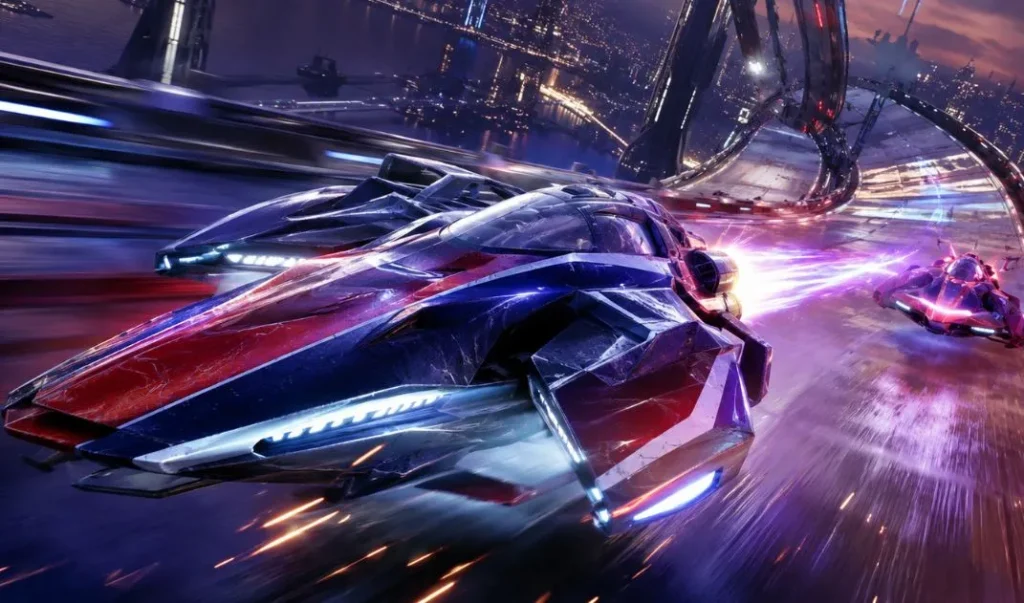
Redout 2 is the kind of racing game that immediately raises one question for old anti-gravity fans: is this finally the modern answer to WipEout? The comparison is unavoidable. Floating ships, futuristic tracks, impossible speed, electronic music, sharp corners, boost management and the feeling that one small steering mistake can throw the whole race away — all the familiar ingredients are here. Yet Redout 2 is not a simple copy of Sony’s cult series. It takes the same broad genre and pushes it toward something more aggressive, faster, harsher and less forgiving.
That difference matters. WipEout was stylish, cold, elegant and weapon-driven. It had a strong visual identity, clean design language and a balance between racing precision and combat chaos. Redout 2 leans harder into raw velocity and control. It wants the player to fight the track as much as the opponents. The ship does not simply glide forward; it needs pitch, strafe, boost timing and constant correction. The result can feel thrilling, but also demanding.
For players who miss futuristic racing, Redout 2 is one of the most serious modern options. It has speed, scale, track variety, ship customization and a long single-player campaign. It also has a steep learning curve that can surprise anyone expecting a relaxed arcade ride. That makes the answer more interesting than “yes” or “no.” Redout 2 may be one of the closest living relatives to WipEout, but it is closer in spirit than in exact feel.
The WipEout shadow and what Redout 2 does differently
WipEout was not only fast. It was fashionable. Its world felt designed by future graphic artists, club promoters and motorsport engineers at the same time. The ships had weight without being heavy. The tracks were challenging, but readable. Weapons created drama, but did not always erase the importance of racing lines. For many players, that mixture became the gold standard of anti-gravity racing.
Redout 2 understands that heritage, but it does not try to reproduce the same mood perfectly. Its world is brighter, louder and more extreme. The tracks twist through deserts, frozen spaces, industrial zones, orbital routes and huge sci-fi structures. The design often feels less like a sleek racing league and more like an endurance test across impossible architecture.
The biggest difference is the absence of classic WipEout-style weapon combat as the central attraction. Redout 2 focuses more on speed, ship handling, boost control and track mastery. That makes it feel closer to a pure anti-gravity time-attack racer than a combat racer. You are still fighting rivals, but the main enemy is usually the circuit itself.
This change gives Redout 2 its own identity. It is not asking whether you can survive a missile attack into the final corner. It is asking whether you can hold a racing line at absurd speed while the track bends, drops, loops and lifts beneath you. The thrill comes from staying in control when the game seems determined to pull control away.
Speed is the main selling point
Redout 2 is built around speed before anything else. Many racing games call themselves fast, but this one makes velocity feel like pressure. At higher classes, corners arrive almost too quickly to process. Track memory becomes essential. A clean lap feels less like casual driving and more like learning a rhythm pattern at high volume.
This speed is not only visual. The control system is designed to keep the player busy. Steering alone is not enough. The ship can strafe sideways, pitch up or down, boost, manage heat and take racing lines that would feel impossible in a grounded car game. When it works, the sensation is excellent: the ship cuts through a corner, boost kicks in at the exit, the track drops away, and the next section appears before there is time to relax.
That intensity is exactly what some WipEout fans want from a modern successor. Redout 2 does not feel slow, safe or softened for casual play. It respects the genre’s old demand for reflexes. The difference is that it may push the demand further than some players expect.
Before the game fully clicks, the player has to accept a few habits that are different from ordinary arcade racing:
- learn the track layout instead of reacting only to what appears on screen;
- use strafing and pitch control as normal parts of cornering, not advanced tricks;
- manage boost carefully, because reckless boosting can overheat the ship or ruin the next corner;
- treat walls as serious threats, not harmless bumpers;
- replay difficult events until the route feels memorized;
- upgrade and tune the ship around handling problems, not only top speed.
Once these habits settle, Redout 2 becomes much more rewarding. The early frustration starts turning into flow. The player stops asking why the ship will not behave and starts understanding how much precision the game expects.
Career mode gives the speed a reason
A futuristic racer can survive on good handling for a while, but it needs structure to keep players returning. Redout 2 tries to solve this through a large single-player campaign. The career mode moves through events, speed classes, challenges and different race types, giving the player a ladder to climb rather than a loose collection of tracks.
This is one of its strongest advantages over many smaller anti-gravity racers. There is a real sense of volume. The game does not feel like a short tribute with a few fast circuits. It wants to be a full racing package: campaign events, ship parts, customization, time trials, multiplayer and a broad track selection.
The career mode can be demanding because difficulty spikes are part of the experience. Some events require not only speed but near-perfect control. That can make progress feel satisfying when you finally master a track, but it can also make the game feel harsh if you only wanted a stylish futuristic racer to play casually after work.
The structure works best when treated like a skill ladder. Redout 2 is not the kind of arcade game where every player immediately wins races through basic driving. It expects improvement. It expects repetition. It expects the player to learn how each ship responds and where each track punishes hesitation.
The campaign is therefore both a strength and a filter. It gives dedicated players a lot to do, but it may push away players who mainly want the smooth elegance and instant readability of WipEout.
Handling: the place where fans will split
The handling model is where Redout 2 becomes most divisive. WipEout veterans may feel at home with the broad concept — anti-gravity craft, floating movement, high-speed turns — but Redout 2 has its own physical language. It can feel sharper, more technical and more punishing.
The ships are highly responsive, but not always simple. Players must manage several inputs at once, especially at higher speeds. The game rewards clean lines, but it also rewards courage. Sometimes the best move is not to slow down safely, but to commit to a corner, strafe correctly, angle the ship and trust the exit. When that works, it feels fantastic. When it fails, the crash can feel brutal.
A useful comparison helps show where the two experiences separate.
| Element | Redout 2 | WipEout-style expectation |
|---|---|---|
| Main focus | Extreme speed and track mastery | Speed mixed with style, combat and clean flow |
| Combat role | Not the central attraction | Often a major part of race drama |
| Handling feel | Technical, fast, demanding | Smooth, readable, elegant but still skill-based |
| Learning curve | Steep, especially in later events | Usually more accessible at first |
| Track design | Huge drops, loops, vertical sections, intense layouts | Sleek futuristic circuits with strong visual identity |
| Best audience | Players who enjoy mastery and speed pressure | Players who want futuristic racing with style and balance |
This is why Redout 2 can feel both like the closest modern WipEout alternative and not quite a replacement. It scratches the same itch for speed and anti-gravity racing, but the hand feel is different. WipEout often felt like racing through a designed future. Redout 2 often feels like surviving a high-speed machine built to test your reactions.
Customization gives the ships personality
Redout 2 adds depth through hovership customization. Players can adjust and upgrade different parts, changing how the ship behaves. This matters because handling preferences vary. Some players want more stability. Others want sharper turning or stronger boost. A ship that feels impossible at first may become more manageable after tuning.
Customization also gives the campaign a sense of growth. The player is not only improving personally; the machine is changing too. Better parts can make earlier problems easier to handle, while higher-speed events introduce new pressure. This creates a loop where progress is both mechanical and skill-based.
The system is not so deep that it becomes a full engineering simulator, but it is meaningful enough to matter. That is the right level for an arcade racer. You can think about the ship without spending more time in menus than on track.
For WipEout fans, this may feel like a modern extension of the old team-and-ship identity. The classic series gave ships distinct personalities through speed, handling and shield values. Redout 2 turns that idea into a more flexible upgrade structure.
Sound, atmosphere and the missing PlayStation cool
One of the hardest parts of comparing any game to WipEout is atmosphere. WipEout had a cultural identity that went beyond mechanics. The visual design, electronic music, fictional teams and PlayStation-era attitude all worked together. It felt like a racing game from a nightclub future.
Redout 2 has strong music and energetic presentation, but the mood is different. It is less minimalist and less iconic. The soundtrack supports speed well, and the environments can look spectacular, but the game’s personality comes more from motion than from design branding. It does not have the same fashion-driven cool that made WipEout feel instantly recognizable.
That is not necessarily a failure. Few games can recreate that exact tone because it belonged to a specific era of gaming culture. Redout 2 is more interested in intensity. Its identity is built around going faster, pushing harder and mastering more violent track shapes.
Players who mainly miss WipEout’s sound and design style may still feel that something is missing. Players who mainly miss anti-gravity speed may find Redout 2 much more satisfying.
Who should try Redout 2
Redout 2 is not the safest recommendation for every racing fan. It is better suited to players who enjoy challenge and do not mind repeating events until the controls become natural. It rewards patience more than casual curiosity.
The game is especially worth trying for a few types of players:
- WipEout fans who miss anti-gravity racing and want a modern game with serious speed.
- F-Zero fans who enjoy extreme velocity and track memorization.
- Arcade racing players who want something more demanding than a simple pick-up-and-play racer.
- Time-trial players who enjoy shaving seconds from laps.
- Racing fans who like customization but do not want full simulation tuning.
It may be less suitable for players who want weapon-heavy combat, easy early victories, licensed motorsport detail or relaxed racing sessions. Redout 2 has accessibility settings and assists, but its personality remains intense. The game wants commitment.
Is it really the closest modern game to WipEout?
Redout 2 is one of the closest modern games to WipEout in the broad sense: futuristic ships, anti-gravity tracks, high speed, electronic music and arcade racing pressure. It clearly belongs in the same family of games. Anyone searching for a current anti-gravity racer will almost certainly find Redout 2 near the top of the conversation.
But “closest” does not mean identical. WipEout’s appeal was a balance of speed, combat, style and design elegance. Redout 2 shifts that balance toward speed, technical control and track intensity. It feels less like a direct spiritual remake and more like a harder, faster cousin that grew up with the same genre memories but chose a more extreme path.
That difference is also why the game matters. A pure WipEout imitation would always live in the shadow of the original. Redout 2 is more interesting because it has its own temperament. It can frustrate. It can overwhelm. It can make a clean lap feel like a physical achievement. It can also deliver the kind of futuristic racing rush that has become rare in modern releases.
Conclusion
Redout 2 is not a perfect replacement for WipEout, but it may be one of the strongest modern answers to the same craving. It understands the pleasure of floating ships, fast tracks, electronic energy and high-speed risk. It also asks more from the player than a nostalgic throwback might. The handling is sharper, the speed is heavier, and the campaign can be unforgiving.
For retro anti-gravity fans, that challenge is part of the attraction. Redout 2 does not simply invite players to remember old futuristic racers. It asks them to become good at one again. The first hours may be rough, especially for anyone expecting instant control. But once the handling begins to make sense, the game opens into something rare: a modern arcade racer with real speed, real depth and a genuine sense of danger.
The closest modern game to WipEout is not the one that copies every surface detail. It is the one that brings back the feeling of racing faster than comfort allows. Redout 2 does that better than most.