The Painscreek Killings does not treat detective work like decoration. It does not fill the screen with bright markers, highlight the next clue in yellow or push the player through a neat sequence of objectives. It drops the player into an abandoned town, gives them the role of journalist Janet, and expects them to do the uncomfortable part of investigation themselves: read, remember, connect, doubt and return to places that did not seem important the first time.
That is why the game still deserves more attention. It is not the slickest mystery game, not the most cinematic thriller and not the easiest recommendation for players who want fast answers. Its strength is quieter. The Painscreek Killings understands that detective fiction becomes more powerful when the player is not merely watching someone solve the case, but personally building the case piece by piece.
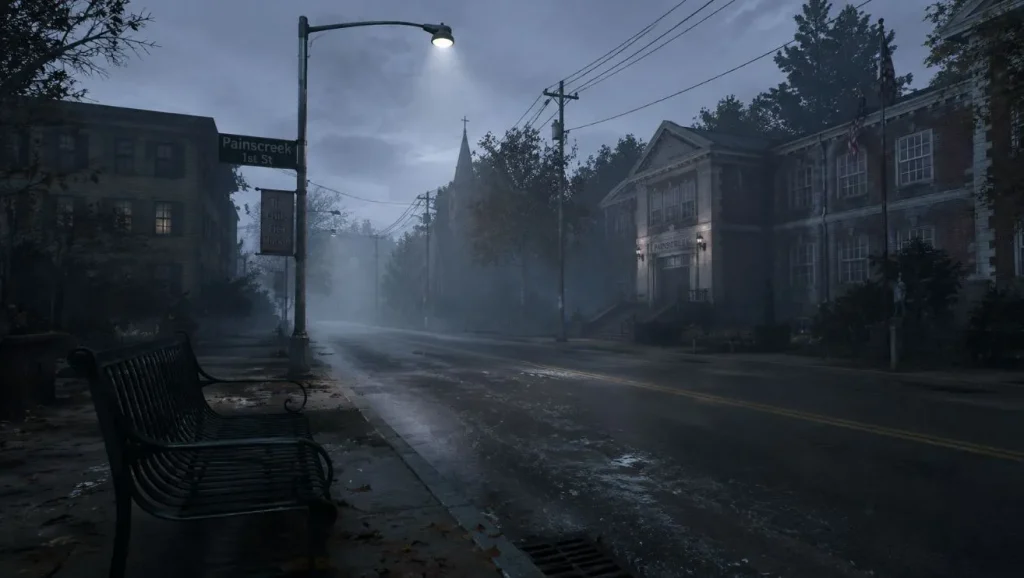
The town of Painscreek is empty, but it does not feel empty in a shallow way. Houses, offices, personal rooms, diaries, locked doors, newspaper clippings and hidden documents all suggest that life once moved through these streets. The player is not chasing a single clue. They are reconstructing a community after the fact, trying to understand how a murder, a disappearance and years of secrets left the place hollow.
A mystery game that trusts the player
Many modern detective games are afraid of letting the player get stuck. That fear is understandable. No developer wants frustration to replace curiosity. But when a mystery game becomes too guided, the act of investigation can lose meaning. The player follows the path, clicks the glowing objects and waits for the character to explain what everything means.
The Painscreek Killings takes the opposite risk. It trusts the player almost too much. There are clues, names, dates, addresses, codes, keys and relationships, but the game does not constantly organize them into a clean case board. The player has to notice patterns. A diary entry may mention a person. A letter may reveal a connection. A locked door may require a code found somewhere far away. A small detail in one building may only make sense after reading something in another.
This creates a rare kind of tension. The pressure does not come from monsters or a ticking timer. It comes from uncertainty. Did you miss something? Did you misunderstand a relationship? Is a name important, or just background? Should you return to that locked cabinet? Was that date written somewhere else?
A strong detective game makes the player feel intelligent without making the mystery feel fake. The Painscreek Killings does this by making progress feel earned. When a connection finally clicks, it feels less like solving a puzzle box and more like understanding a person.
The town is the real case file
Painscreek works because it is not simply a map. It is a physical archive. The houses are not neutral rooms with collectibles scattered around. They feel like private spaces after the people have gone. A bedroom can reveal personality. An office can reveal power. A clinic, mansion, cemetery or police station can change how the player understands the town’s social structure.
The game is often described as a walking sim, but that label can be misleading if it suggests passivity. Yes, the player walks, reads and explores more than they fight or perform complex mechanical actions. But the walking is investigative. Every trip across town becomes part of a mental route: where did that key fit, who lived near whom, which path connects the church to the cemetery, why does one locked room matter more than another?
The slower pace gives the town weight. You begin to remember places not because the game marks them, but because you personally needed them. The geography becomes connected to thought. A mystery that might feel abstract in a menu becomes physical because the player has to move through the remains of it.
This is one of the game’s best tricks. It turns backtracking into reconsideration. Returning to an old location is not just a chore. It can be a new reading of the same space after learning what happened there.
Why taking notes changes everything
The Painscreek Killings is at its best when played with a notebook, a text file or careful screenshots. That may sound old-fashioned, but it is part of the design’s power. The game asks the player to behave like an investigator rather than a tourist. Writing things down changes how the mystery feels.
Instead of waiting for the interface to remember everything, the player starts building a private case record. Names become important. Dates start to cluster. Locations form patterns. A number that seemed random becomes a possible code. A family relationship becomes suspicious only after another document reframes it.
A useful note-taking approach does not need to be complicated. It only needs to separate the kinds of information that matter most:
- Names of residents, officials, victims and people mentioned in documents;
- Dates connected to deaths, disappearances, letters and newspaper reports;
- Locked doors, safes, drawers and places that need keys or codes;
- Family relationships, friendships, rivalries and romantic connections;
- Suspicious contradictions between different accounts;
- Locations that seem empty now but are mentioned repeatedly elsewhere.
This kind of note-taking slows the player down, but in the right way. The point is not to turn the game into homework. The point is to make every discovery feel like it belongs to your investigation, not to an automatic journal.
The difference between atmosphere and horror
The Painscreek Killings is not a pure horror game, but it understands unease. Its abandoned town creates the feeling that something is missing, and that absence becomes more unsettling than a constant threat. Empty houses in daylight can feel more disturbing than dark corridors if the player begins to understand what happened inside them.
The game does not rely on constant jump scares. Instead, it uses silence, distance and discovery. A quiet room can become tense because a diary changes what the room means. A locked area can feel threatening because the player has imagined what might be behind it for hours. The town’s emptiness works as a kind of pressure: nobody is there to stop you, but nobody is there to reassure you either.
This is a different kind of fear from survival horror. The player is not usually afraid of being attacked. They are afraid of uncovering something that makes the whole town feel worse. That is closer to classic mystery fiction, where the final truth can be more disturbing than the act of reaching it.
The game’s strongest atmosphere comes from restraint. It does not need every house to scream its importance. It lets ordinary places become suspicious slowly.
Where the game feels rough and why that matters less than expected
The Painscreek Killings is not a flawless production. It has the limitations of a small independent game. Some animations, environments and interactions can feel plain compared with larger-budget releases. The pacing can be slow. The amount of reading may be too much for players who want constant cinematic movement. Getting stuck is a real possibility, especially for anyone who does not take notes.
These rough edges are worth acknowledging because they shape who will enjoy the game. The Painscreek Killings is not built for players who want a mystery solved at the speed of a television episode. It asks for patience. It expects attention. It gives fewer comforts than many modern investigation games.
But the roughness also supports part of its charm. The game feels handmade around one strong idea: what if the player had to actually investigate? Not pretend to investigate, not watch a detective investigate, but build the answer through documents, spaces and logic.
A quick comparison shows why its strengths and weaknesses are closely connected.
| Game element | What works well | What may frustrate some players |
|---|---|---|
| Investigation design | Real clue connection and player-led deduction | Few safety rails when stuck |
| Town exploration | Semi-open spaces that feel like a case archive | Backtracking can feel slow |
| Story delivery | Diaries, letters and documents build layered secrets | Heavy reading may not suit everyone |
| Atmosphere | Quiet unease without constant cheap scares | Less intense for players wanting direct horror |
| Puzzle structure | Codes and keys feel tied to investigation | Missed notes can block progress |
| Presentation | Clear, grounded indie mystery style | Modest visuals and limited polish |
The game is therefore easy to misunderstand. Its slower structure is not a failure of pace alone. It is part of the detective fantasy. The player has to decide whether that fantasy is appealing enough to accept the friction.
Why the mystery works better without constant guidance
The central murder case matters, but the wider mystery is about the town’s emotional architecture. Who had power? Who was hiding pain? Who lied? Who protected whom? Who benefited from silence? The Painscreek Killings becomes stronger when the player realizes that the case is not isolated from the town. It is tangled in families, institutions, secrets and social pressure.
Guidance would weaken that feeling. If the game constantly told the player which clue mattered, every document would become a stepping stone instead of a possible discovery. By leaving more responsibility with the player, the game makes each clue feel uncertain until it fits.
That uncertainty is what detective games often lack. In many mysteries, the player instantly knows when they have found the important object because the music changes, the character reacts or the quest log updates. In Painscreek, importance is sometimes delayed. A detail can sit quietly in your notes for hours before becoming the missing link.
This is why the final act feels earned for players who commit to the process. The solution is not only delivered. It is assembled. The player arrives at the truth with a sense of ownership.
Who should play The Painscreek Killings
The Painscreek Killings is not for every mystery fan, but it is ideal for a specific kind of player. It rewards curiosity more than reflexes. It rewards memory more than speed. It rewards careful reading more than mechanical mastery.
Players most likely to enjoy it are those who want:
- A detective game that does not over-explain its clues;
- An abandoned-town mystery with a slow, serious mood;
- Investigation built around documents, codes, keys and relationships;
- A story that unfolds through place rather than constant cutscenes;
- The satisfaction of solving something personally;
- A walking sim with real deductive pressure.
Players who dislike reading, note-taking, backtracking or getting stuck may find the experience too dry. That does not make the game weak. It means the design has a strong identity and does not soften itself for every taste.
Why more people should play it
The Painscreek Killings deserves more attention because it does something many mystery games only claim to do. It makes investigation feel like work, but meaningful work. It gives the player a town, a dead woman, a trail of documents and enough freedom to get lost inside the case. That may sound simple, yet it is surprisingly rare.
The game also shows how a small studio can compete through design focus rather than budget. It does not need celebrity actors, huge set pieces or advanced facial animation to create mystery. It needs a place that makes sense, secrets that connect and enough trust in the player to let silence do its job.
There is also a particular pleasure in playing a game that resists modern impatience. The Painscreek Killings does not rush to entertain every second. It allows the player to sit with uncertainty. It makes empty streets useful. It makes paper matter. It makes a locked door memorable because the player may spend hours wondering what it hides.
Conclusion
The best reason to play The Painscreek Killings is not that it is perfect. It is that it gives a feeling many players look for and rarely find: the feeling of being alone with a case and slowly earning the truth. Its detective work is not glamorous. It is reading, walking, checking, doubting, returning and connecting. That may sound modest, but it creates a kind of immersion that more expensive games often miss.
The town of Painscreek stays with the player because it becomes personal through effort. You remember the buildings because you searched them. You remember the names because you wrote them down. You remember the solution because you helped build it from pieces that once seemed unrelated.
That is why more people should play it. Not because it is the loudest mystery game, but because it understands the quiet satisfaction of investigation. The Painscreek Killings makes the player feel less like a passenger in a detective story and more like the person responsible for finally opening the file no one wanted opened.