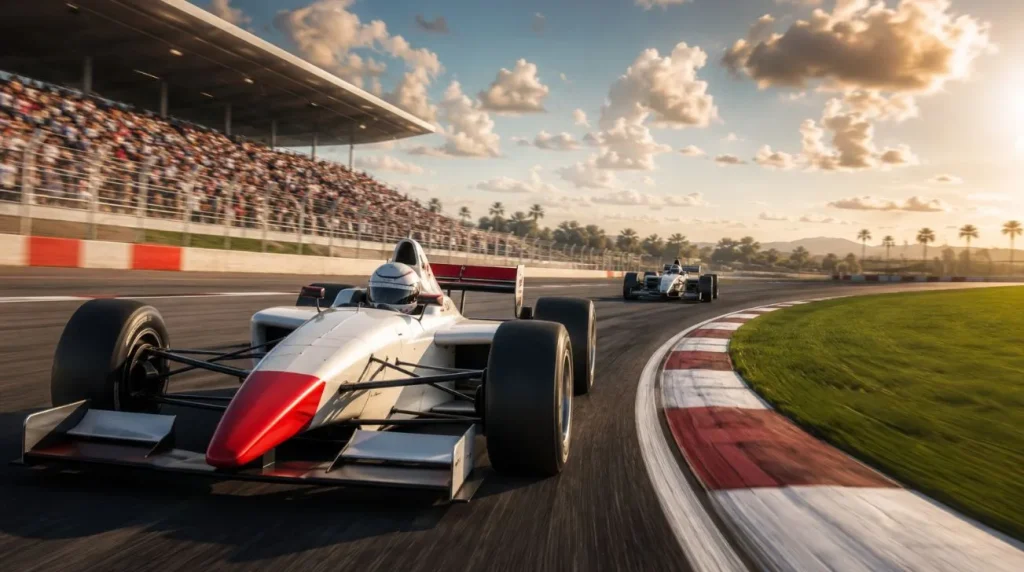
New Star GP feels like a racing game from a different timeline: one where arcade motorsport never became obsessed with photorealism, telemetry screens and complex tyre models. It is bright, fast, clean and deliberately old-school, but it is not empty nostalgia. Under the chunky retro look sits a surprisingly structured racing game about timing, upgrades, rivalries, pit decisions and the slow climb from early-career machinery to faster, more demanding eras.
For retro fans, the appeal is immediate. The cars are simple to read. The tracks are colourful. The racing line matters, but the game does not ask the player to treat every corner like a simulator test. It wants speed, rhythm and confidence. The steering is accessible enough for quick sessions, yet there is enough depth to make better braking, cleaner exits and smarter race management feel rewarding.
That balance is the reason New Star GP stands out. It is not trying to be the official Formula 1 game, and it is not pretending to replace serious simulation. It works because it understands the pleasure of arcade racing: the instant grip of a corner, the panic of a rival diving inside, the decision to pit now or stretch one more lap, the satisfaction of upgrading a weak car into something that can finally fight at the front.
A retro racing game with modern structure
New Star GP looks back to the 1990s, but it is not just a visual tribute. The game uses retro styling as a way to make the action clear. Corners are readable, cars are easy to distinguish, and the screen does not drown the player in unnecessary detail. That matters because arcade racing depends on immediate reaction. When the car moves quickly, the player needs to understand the track at a glance.
The structure is more modern than the first impression suggests. Career mode moves through different decades of racing, beginning in the 1980s and developing toward the present day. This gives the game a sense of progression that many pure arcade racers lack. The player is not only jumping between random tracks. There is a wider campaign, with cars, rivals, team development and changing race demands.
The team-management side gives the racing extra weight. Upgrades matter because they shape how competitive the car feels. Support-team development gives the player choices away from the circuit. Strategy decisions, especially around tyres and pit stops, add pressure without turning the game into a heavy management simulator.
This is where New Star GP finds its identity. It has the approachable handling of an arcade racer, but it borrows just enough from motorsport structure to make seasons feel meaningful. A win feels good because the race was fun. A championship push feels better because the player has been building toward it.
Why the driving feels accessible without becoming flat
The best arcade racing games are easy to start and harder to master than they first appear. New Star GP follows that idea. The player can understand the basics quickly: accelerate, brake, turn, avoid contact, find the racing line and use the car’s speed wisely. But better laps require more than holding the throttle and hoping.
Corners punish poor timing. Brake too late and the car runs wide. Turn in too early and the exit suffers. Fight too aggressively and rivals can turn a clean race into a messy one. The game does not bury the player under simulation physics, but it still rewards smoother driving.
There is also a rhythm to how races unfold. The early laps may be about finding position. The middle section may be about managing tyres or avoiding damage. The final lap may be about defending a narrow lead or risking one last move. Because races are shorter and sharper than in a full simulator, every mistake feels visible.
The driving works especially well for players who miss the simplicity of older racing games but still want some modern feedback. It gives enough control to feel skill-based and enough forgiveness to stay enjoyable after a mistake. That is a difficult balance, and it is the main reason retro fans are likely to stay with the game beyond the first nostalgic impression.
Career mode gives the game its long-term pull
A simple arcade racer can be fun for an evening. Career mode is what gives New Star GP a reason to keep returning. The player moves through racing eras, upgrades the car, develops the team and faces different event types. This creates a loop that is easy to understand: race, earn progress, improve, take on stronger rivals, repeat with a better chance.
The decade-based structure is one of the smartest ideas in the game. It lets the player feel time moving forward. Cars become faster. Expectations rise. Tracks and opponents demand cleaner driving. The retro presentation also benefits from this format because the game can lean into motorsport history without needing official licences or real-world names.
Career mode also avoids one common problem in arcade racers: races that feel disconnected. Here, even a difficult finish can still matter if it provides resources, reveals a weakness or sets up the next upgrade decision. A poor race does not always feel like wasted time. It can become part of the team’s development.
The main career loop can be understood through several connected layers:
- Driving skill improves through cleaner braking, smoother corner exits and better overtaking.
- Car upgrades make weak areas easier to manage, such as speed, handling or reliability.
- Support-team choices affect the feeling of preparation between events.
- Race strategy adds decisions around pits, tyres and timing.
- Rival battles give individual races more personality than a standard grid would.
- Championship progress turns short arcade events into a wider campaign.
This combination makes the game more substantial than its cheerful look suggests. Retro style brings players in, but career depth is what keeps the game from feeling like a brief novelty.
The racing modes keep the pace varied
New Star GP is not built only around standard Grand Prix races. It includes different event types and a championship mode, which helps break the rhythm and gives players more than one way to engage with the game. Some events test pure speed. Others push consistency, overtaking, survival or quick adaptation.
That variety is important because arcade racing can become repetitive if every race asks the same question. New Star GP keeps changing the pressure. Sometimes the challenge is winning from a poor position. Sometimes it is staying clean. Sometimes it is squeezing the best lap from a car that does not yet feel fully developed.
The game also includes split-screen multiplayer for up to four players, which fits the retro spirit perfectly. Local multiplayer is part of the genre’s older identity. Sitting with friends, racing on the same screen, making mistakes in the same corner and arguing over a late overtake can be more memorable than chasing online rankings. New Star GP understands that arcade racing is often at its best when it becomes social.
A clear view of the main appeal helps show why the game works for different types of players.
| Player type | What they may enjoy most | Possible limitation |
|---|---|---|
| Retro racing fans | Visual style, simple controls and local multiplayer | May want even more classic track variety |
| F1-style fans | Pit strategy, team progress and championship feel | No official licences or real teams |
| Casual players | Fast races and easy first steps | Later events still require clean driving |
| Completion-focused players | Career progression, upgrades and event variety | Repetition may appear in longer sessions |
| Local multiplayer groups | Split-screen races and quick competition | Best when everyone enjoys arcade handling |
The game is strongest when approached on its own terms. It is not a licensed Formula 1 simulator. It is a retro-styled arcade motorsport game with enough strategy to make racing decisions matter.
Why lack of official F1 licensing is not a weakness
New Star GP clearly borrows the emotional shape of Formula-style racing: single-seaters, pit stops, championships, decades of motorsport evolution and the tension of wheel-to-wheel battles. But it does not depend on official F1 branding. That may sound like a limitation, yet it actually helps the game.
Without real teams, real drivers and official calendars, the developers can build their own racing world. The focus shifts from authenticity to feel. The cars do not need to match exact real-world regulations. The tracks do not need to copy famous circuits. The career does not need to follow modern F1 politics, penalties or calendar structure. Everything can be tuned for pace and clarity.
This freedom suits the retro approach. Many classic racing games were not loved because they reproduced motorsport exactly. They were loved because they captured speed, risk and competition in a form that felt immediate. New Star GP works in that tradition. It is Formula-inspired rather than Formula-bound.
For players who demand licensed drivers, real liveries, official circuits and broadcast-style presentation, the game may feel too abstract. For players who want the spirit of old arcade racing with some motorsport strategy, the absence of official branding is not a problem. It may even be part of the charm.
Where the game may not suit every player
New Star GP is easy to recommend to retro racing fans, but it is not built for everyone. Players who want full simulation physics, real car setups, long race weekends and deep mechanical tuning may find it too light. The game has strategic elements, but it is still an arcade racer at heart.
Some players may also want online multiplayer as a central feature. New Star GP’s local split-screen focus is excellent for couch play, but it is not the same as a large online competitive scene. Players who mainly race against strangers online may want a different game.
The visual style can also divide opinion. For many retro fans, the clean low-poly look is part of the appeal. For players who judge racing games by visual realism, it may seem too simple. That reaction is understandable, but it misses the point. New Star GP is not trying to look like a television broadcast. It is trying to look like a polished memory of arcade racing.
Before trying the game, it helps to know what kind of racing experience you want:
- Choose New Star GP if you want fast arcade handling with a motorsport career structure.
- Avoid it if your main interest is realistic simulation and official F1 detail.
- Try it for local multiplayer if you miss split-screen racing.
- Treat career mode as the main draw if you enjoy progression and upgrades.
- Expect charm and rhythm rather than strict motorsport realism.
That makes the game easier to judge fairly. It succeeds when measured as an arcade racer with depth, not as a competitor to the most technical racing simulations.
Why retro fans should give it a chance
The strongest argument for New Star GP is that it understands what made older arcade racers stick in memory. It is readable, quick, colourful and satisfying in short bursts, but it also gives the player a campaign with enough structure to make improvement feel meaningful. That is rarer than it should be.
Many modern racing games chase scale: larger maps, bigger garages, more licensed cars, more systems, more online services. New Star GP goes in another direction. It narrows the experience, sharpens the loop and focuses on racing that feels good quickly. For retro fans, that directness matters.
The game also has personality. The decade-based career gives it a playful motorsport history. The rival structure makes races feel less anonymous. The team upgrades create a sense of ownership. The soundtrack and visual style support the feeling that the game is both new and deliberately old-fashioned.
It is not nostalgia alone. Nostalgia may be what makes a player notice New Star GP, but the handling and career loop are what make it worth staying with.
Conclusion
New Star GP is the kind of arcade racer that respects retro racing without feeling trapped by it. It has simple controls, bright visuals and fast races, but it also offers career progression, team upgrades, strategy choices and local multiplayer. That mix makes it more substantial than a quick throwback and more approachable than a serious simulator.
The game is especially easy to recommend to players who grew up with arcade racers, enjoy Formula-style competition and want something lighter than a full F1 simulation. It works well for short sessions, but the career mode gives it enough shape for longer play. The best moments come when the car feels just upgraded enough, the tyres are fading, a rival is close behind and one clean final lap decides the result.
New Star GP does not need real F1 teams to capture the pleasure of open-wheel racing. It captures the fantasy instead: fast cars, bright tracks, tense overtakes, simple controls and the feeling that one better corner can change the whole race. For retro fans, that may be exactly the kind of racing game that has been missing.