Marvel Tokon: Fighting Souls is shaping up to be one of the most intriguing fighting game announcements of 2026. After years of speculation about where Marvel’s competitive fighting presence would go next, this project introduces a new direction — stylistically bold, mechanically layered, and clearly built with both esports viability and long-term support in mind.
Rather than recycling the tag-based chaos of previous Marvel fighters, Tokon: Fighting Souls appears to reposition the franchise with a distinct identity. It blends high-speed anime-inspired combat aesthetics with grounded competitive fundamentals, aiming to attract hardcore fighting game community players while remaining accessible to newcomers drawn in by Marvel’s global brand power.
What Is Marvel Tokon: Fighting Souls?
Marvel Tokon: Fighting Souls is a 2.5D competitive fighting game scheduled for release in 2026. Developed with a strong emphasis on stylized combat presentation and character-driven mechanics, the game introduces a fresh roster approach and a new combat system that prioritizes “Soul States” over traditional assist-heavy tag chaos.
Unlike earlier Marvel titles that leaned heavily into 3v3 tag formats, Tokon seems to center on 1v1 and 2v2 variations, with a focus on strategic momentum shifts rather than constant screen-filling supers. The name “Tokon” — suggesting a decisive duel or fierce clash — reflects that design philosophy. The combat is still fast, but it is cleaner, more deliberate, and more readable from a competitive spectator perspective.
This shift is significant. The modern fighting game scene demands clarity for streaming, tournament structure balance, and long-term competitive depth. Tokon appears to be built with that ecosystem in mind from the ground up.
Core Gameplay Mechanics and Combat System
At its core, Marvel Tokon: Fighting Souls introduces the Soul Gauge system. Every character builds Soul Energy during neutral exchanges, successful combos, and defensive parries. Once charged, players can activate Soul States that temporarily alter character properties — unlocking enhanced abilities, armor frames, or altered combo routes.
This mechanic creates layered decision-making. Do you spend Soul Energy early for pressure extension, or save it for a late-round momentum reversal? The design encourages adaptation rather than autopilot combo repetition.
The combat system emphasizes:
- Precision movement with air-dash restrictions to reduce chaotic screen flooding
- Cancel windows that reward tight timing rather than mash-heavy chains
- A universal parry mechanic that encourages active defense
- Character-specific Soul transformations that redefine matchups mid-fight
- A stamina-based defensive option to prevent infinite pressure loops
What stands out is how the game appears to balance spectacle with competitive structure. Visual effects are bold but not overwhelming. Hit sparks and super animations are dramatic, yet quick enough not to disrupt tournament pacing.
Confirmed and Rumored Character Roster
Marvel Tokon: Fighting Souls is expected to feature a carefully curated roster at launch, with a mix of classic Marvel icons and newer-generation heroes. Early promotional material suggests a focus on balanced archetypes rather than sheer roster size.
The rumored and teased lineup includes:
| Character | Archetype | Soul State Effect | Playstyle Focus |
|---|---|---|---|
| Iron Man | Zoner/Hybrid | Enhanced projectile control | Mid-range pressure |
| Spider-Man | Rushdown | Speed amplification | Mobility & mixups |
| Black Panther | Counter-based | Parry damage boost | Reactive offense |
| Doctor Strange | Technical | Spell stance changes | Setplay & traps |
| Captain Marvel | Power striker | Armor activation | Direct pressure |
| Scarlet Witch | Control mage | Reality distortion field | Space manipulation |
Before analyzing this roster, it’s important to understand what makes it compelling. Instead of stacking only high-profile cinematic characters, the selection appears gameplay-driven. Each character fills a strategic niche within competitive structure.
After reviewing these archetypes, a clear design direction becomes visible: Marvel Tokon prioritizes matchup diversity over fan-service overload. Every fighter has a defined identity tied to Soul mechanics, reinforcing strategic depth rather than chaotic overlap.
Visual Direction and Art Style
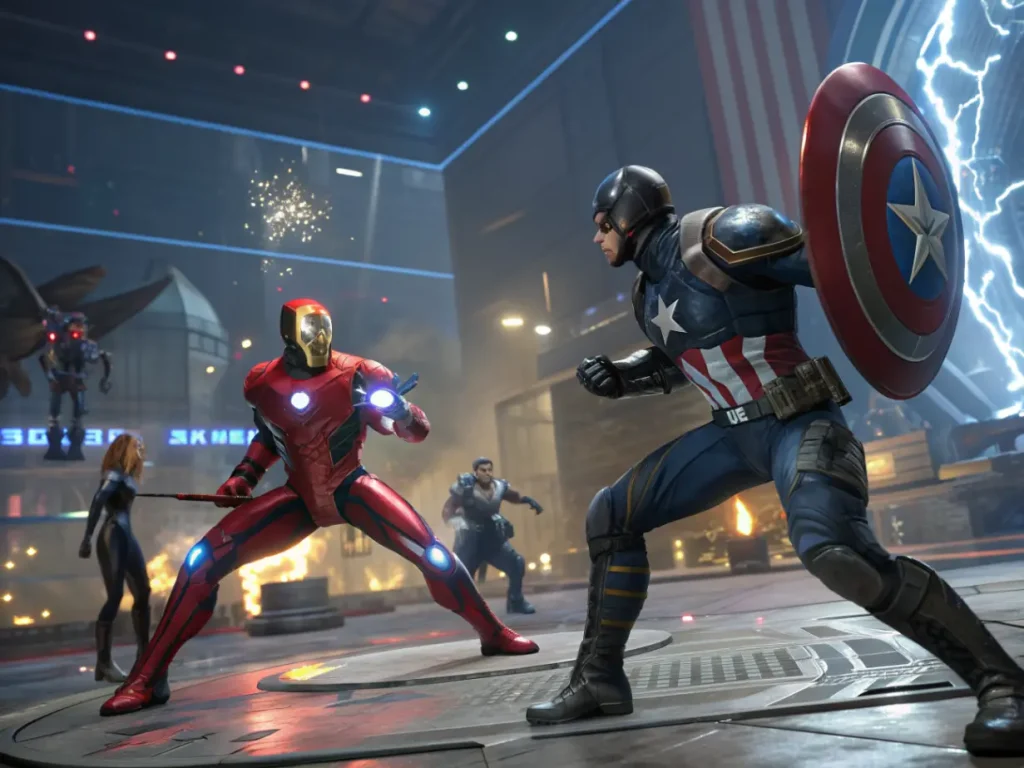
Marvel Tokon: Fighting Souls adopts a stylized anime-inspired rendering approach rather than hyper-realistic MCU visuals. Character outlines are bold, shading is dynamic, and animations exaggerate motion arcs to enhance clarity during high-speed exchanges.
This approach serves two major purposes. First, it differentiates Tokon from previous Western-style Marvel fighters. Second, it increases readability — a crucial element in modern competitive design. Fighting games succeed when spectators can instantly understand what’s happening on screen.
Stage design also appears deliberate. Arenas are vibrant but not distracting. Background animations exist, yet they do not overpower gameplay clarity. Lighting shifts during Soul State activation subtly highlight power spikes without cluttering the screen.
The aesthetic direction suggests long-term support through alternate skins, seasonal visual updates, and tournament branding integration.
Competitive Potential and Esports Outlook
Marvel Tokon: Fighting Souls enters a competitive landscape already populated by titles like Street Fighter 6, Tekken 8, and anime-style arena fighters. To survive, it needs more than brand recognition. It needs mechanical integrity.
The Soul Gauge system could become the defining competitive layer. Because Soul activation changes matchup dynamics mid-round, tournaments may see adaptive meta evolution faster than traditional fighters. Players will need matchup-specific knowledge for both base forms and Soul-enhanced states.
If balanced correctly, Tokon could carve out a space between traditional footsie-heavy fighters and hyper-chaotic tag games. That hybrid identity may appeal to both legacy Marvel players and newer FGC audiences.
From an esports perspective, the following elements will determine long-term success:
- Rollback netcode stability
- Transparent balance patch cadence
- Strong training mode tools
- Clear tournament spectator interface
- Cross-platform support
Marvel’s global brand also increases sponsorship potential. If structured correctly, Tokon could integrate directly into major esports circuits within its first competitive year.
Game Modes and Content Depth
Beyond competitive play, Marvel Tokon: Fighting Souls reportedly includes a cinematic story mode centered around the “Soul Fragment Crisis” — a narrative device that justifies character transformations and alternate forms.
Story mode is expected to blend traditional arcade ladder progression with branching dialogue sequences. While story content may not define competitive success, it broadens the player base and increases launch engagement.
Other anticipated modes include ranked online matchmaking with visible Elo-style rating tiers, casual lobbies with spectator slots, and seasonal challenge towers that rotate modifiers tied to Soul mechanics.
This layered approach signals that Tokon is not positioning itself as a niche FGC-only title. It aims to capture casual Marvel fans without compromising mechanical depth.
Technical Performance and Platforms
Marvel Tokon: Fighting Souls is expected to release on current-generation consoles and PC in 2026. Performance benchmarks target stable 60 FPS gameplay — essential for competitive fighting integrity.
Rollback netcode appears to be a foundational feature rather than a post-launch patch. That detail alone could determine player retention. Modern fighting communities expect smooth online play from day one.
Graphically, the game balances high-resolution character models with optimized particle effects. Soul activations may increase visual intensity, but developers appear conscious of maintaining frame stability during high-action sequences.
If cross-play is fully implemented, Tokon’s competitive pool could unify globally rather than fragment across platforms.
Why Marvel Tokon: Fighting Souls Matters
Marvel Tokon: Fighting Souls represents more than another licensed fighting game. It reflects an evolution in how franchise-based fighters are structured. Instead of leaning solely on nostalgia or cinematic popularity, it seems engineered with competitive clarity and modern esports realities in mind.
The Soul mechanic differentiates it structurally. The visual direction sets it apart stylistically. The roster philosophy prioritizes gameplay identity over sheer quantity.
If executed correctly, Marvel Tokon could become the definitive Marvel fighting experience of this generation — one that respects competitive fundamentals while delivering the cinematic intensity players expect.
Conclusion
Marvel Tokon: Fighting Souls arrives in 2026 with ambitious goals. It aims to redefine Marvel’s place in the fighting game genre by combining strategic Soul mechanics, stylized visual clarity, and esports-ready design.
The real test will come post-launch — balance updates, netcode reliability, and community adoption will ultimately determine its longevity. But based on its revealed systems and direction, Tokon has the potential to stand not just as another Marvel title, but as a competitive pillar in the modern fighting landscape.